Waterloo Medal (1815)
It was announced in the London Gazette on April 23, 1816 that the Prince Regent conferred the Waterloo Medal upon every officer, non-commissioned officer, and soldier of the British Army (including members of the King's German Legion), who took part in one or more of the following battles: (1) Battle of Ligny (June 16, 1815); (2) Battle of Quatre Bras (June 16, 1815); and (3) the Battle of Waterloo (June 18, 1815).
The 37mm, silver medal was issued in 1816–1817. The obverse bears the effigy of the Prince Regent with the inscription, GEORGE P. REGENT, while the reverse depicts the seated figure of Victory with the words WELLINGTON above and WATERLOO below and the date JUNE 18 1815 in the exergue. A total of 37,500 were issued.


The 1815 Waterloo Medal Obverse & Reverse
This was the first medal issued by the British Government to all soldiers present during an action. The Cromwell Medal (1630) was awarded by Parliament and not on behalf of the Regent. The Military General Service Medal (MGSM) commemorates earlier battles, but was not issued until 1848. The Waterloo Medal was also the first campaign medal awarded to the next-of-kin of men killed in action. It was designed by Thomas Wyon following a design competition. The medal is unusual in that the head of the Prince Regent (later to become King George IV in 1820) is depicted, while all other campaign awards depict a bust of the reigning king or queen.
The Table Top Waterloo Medal
Benedetto Pistrucci (1783–1855) was an Italian gem-engraver, medalist, and coin engraver who was commissioned to create a large Waterloo medal. It took him thirty years to complete. The large piece, which measured 5.3 inches (130mm) in diameter, was planned to be awarded to the victorious generals and national leaders who had defeated Napoleon.
The center of the obverse depicts the four allied rulers: George, Prince Regent (although not yet a king, he was exercising the monarch's powers due to the illness of his father, George III), Emperor Francis I of Austria, Tsar Alexander I of Russia, and King Frederick William III of Prussia. At top of the obverse, Apollo is seen in his chariot as he restores the day. Following the chariot are Zephyr - who scatters flowers, symbolic of peace - and Iris. The carriage flies in the sky towards Castor and Pollux, representing the constellation Gemini and symbolizing the period of the Zodiac when Waterloo took place. The twins are armed with spears and are meant as the apotheosis of the victorious generals, Wellington and Blucher. Themes, the goddess of justice, appears before the rulers, as reminder that justice, more than power, secures their rule. Under her are seen the Fates, their subservient position meaning that human fate will henceforth be determined by justice. Opposite Themes, behind the rulers, is a man armed with a club, seated under an oak tree - he represents power. Beneath him are the Furies, symbolizing that human actions and passions are subject to power, and at the bottom is a figure representing night, fleeing.
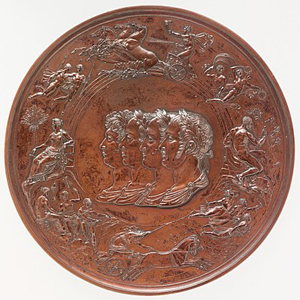
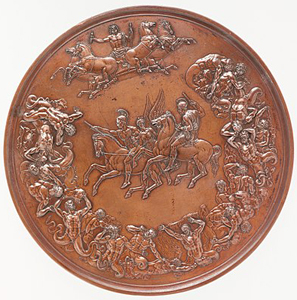
Benedetto Pistrucci's Large Waterloo Medal
The reverse has at its center equestrian figures meant to be Wellington and Blucher, with Victory between them, guiding them to battle. At the top of the reverse is Jupiter. Taking up the rest of the circumference of the medal are 19 figures of giants whom Jupiter has struck down. They represent the defeated enemy and number one for every year of the war.
In 1990, the Royal Mint struck a reduced-size collector's version in bronze for the 175th anniversary of the battle. It struck one in silver, also for collectors, for the 200th anniversary in 2015, with Pistrucci's inscriptions, eliminated from the original, from the wax models restored. In 2014, as part of the preparations for the battle's bicentenary, the Worcestershire Medal Service (Queen Elizabeth II's official medalist), on behalf of the London Mint (a private firm) prepared full-size versions in silver. They were presented to the ambassadors of Austria, Russia, and Germany (as successor to Prussia), with the Queen to receive one later, and were also made available for sale to the public at 3,900 BPS each.
Other Waterloo Medals
Waterloo Medals were also issued by: (1) the Duchy of Brunswick; (2) the Hanoverian Army; (3) the Duchy of Nassau; (4) Prussia; and (5) Holland.
Duchy of Brunswick
The 34mm round, bronze Duchy of Brunswick medal was made from captured French cannons. Medals for officers were gilded. The obverse depicts a left-facing profile of the fallen Duke of Brunswick, Frederick William. Around the edge is the inscription, in German Script, FRIEDRICH WILHELM HERZOG. The reverse of the medal bears the date, 1815, in the center, surrounded by a wreath of oak and laurels. Approximately 6,000 Brunswick troops fought in the war.
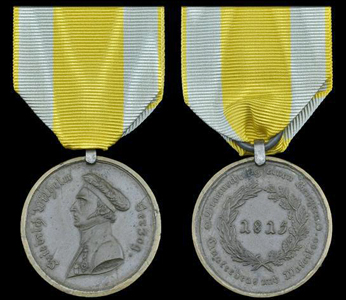
Duchy of Brunswick Waterloo Medal
Hanoverian Waterloo Medal
The obverse of the Hanoverian Waterloo Medal, like the British Waterloo Medal, has a profile and laureate head of the Prince Regent with the legend GEORG. PRINZ. REGENT, 1815, inscribed around it. The was issued to all members of the Hanoverian army who fought in the battles of Quatre Bras and Waterloo June 16–18, 1815. The reverse has two branches of laurel and a breastplate, with two spears and two colors crossed on either side. Below this is the date, WATERLOO JUN. XVIII, and above, in Roman letters, HANNOVER SCHER TAPFERKEIT. The soldier's name, regiment, etc is indicated around the rim. The Hanoverian troops, excluding those of the King's German Legion, present on the 16th, 17th, and 18th of June at Battle of Quatre Bras and Waterloo, under the command of General Charles Alten, amounted to approximately 11,000 men.
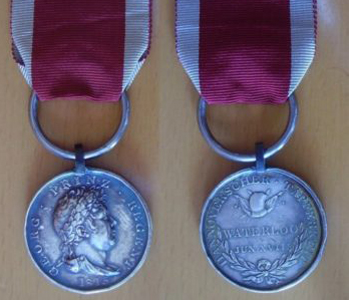
Hanoverian Waterloo Medal
Duchy of Nassau
The 28.9mm, silver Waterloo Medal of the Duchy of Nassau was established by Frederick Augustus, Duke of Nassau on December 23, 1815. It features his effigy on the obverse surrounded by the inscription, FREDRICH AUGUST HERZOG ZU NASSAU. The reverse features winged victory placing a wreath upon a figure's head, surrounded by the inscription, DEN NASSAUISCHEN STREITERN BLY WATERLOO and the date DEN 18 JUNI 1815 in the exergue. Nassau fielded approximately 3,000 troops.

Duchy of Nassau Waterloo Medal
Prussia
Combatants received the circular bronze medal, reputedly made from the captured French cannon brass. Non- combatants received the oval version. The obverse features a cross pattee with a wreath and the date 1815 at its center. The reverse features four clasped arms.
The obverse of the medal features a cross pattee with rays between the arms, the date 1815 centrally within a laurel wreath. The reverse features the crowned cipher of Friedrich Wilhelm III above the inscription PREUBENS TAPFERN KRIEGERN (Prussia’s brave warriors) circumscribed GOTT WAR MIT UNS, IHN SEY DIE EHRE (God was with us to Him the glory) On the edging is inscribed AUSEROBERTEM GESCHUTZ (from captured cannon).
The medal exists with the obverse cross featuring both squared and rounded edges and with the dates: 1813, 1814, 1813/1814 and 1815.
The Prussians fielded an approximately a 50,000 man army under Gebhard Leberecht von Blucher, Furst von Wahlstatt.

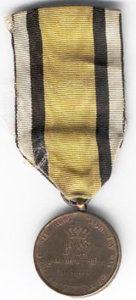

Prussian Waterloo Medals Combatant & Non-Combatant
Holland
The Dutch soldiers had to wait until 1865 before a medal was produced to celebrate the 50th anniversary of Waterloo. It was awarded to those who fought for the independence of the Kingdom of the Netherlands. The obverse of the dual-sided, five-armed, silver cross features the date, 1815 inside of a central roundel. The reverse has the date 1813. The medal is encountered with the sides reversed.
Approximately 17,000 Dutch-Belgian troops (infantry, cavalry and artillery) fought independently of Wellington's command, under Willem van Oranje-Nassau.

Dutch Cross for Waterloo
It was announced in the London Gazette on April 23, 1816 that the Prince Regent conferred the Waterloo Medal upon every officer, non-commissioned officer, and soldier of the British Army (including members of the King's German Legion), who took part in one or more of the following battles: (1) Battle of Ligny (June 16, 1815); (2) Battle of Quatre Bras (June 16, 1815); and (3) the Battle of Waterloo (June 18, 1815).
The 37mm, silver medal was issued in 1816–1817. The obverse bears the effigy of the Prince Regent with the inscription, GEORGE P. REGENT, while the reverse depicts the seated figure of Victory with the words WELLINGTON above and WATERLOO below and the date JUNE 18 1815 in the exergue. A total of 37,500 were issued.
The 1815 Waterloo Medal Obverse & Reverse
The Table Top Waterloo Medal
Benedetto Pistrucci (1783–1855) was an Italian gem-engraver, medalist, and coin engraver who was commissioned to create a large Waterloo medal. It took him thirty years to complete. The large piece, which measured 5.3 inches (130mm) in diameter, was planned to be awarded to the victorious generals and national leaders who had defeated Napoleon.
The center of the obverse depicts the four allied rulers: George, Prince Regent (although not yet a king, he was exercising the monarch's powers due to the illness of his father, George III), Emperor Francis I of Austria, Tsar Alexander I of Russia, and King Frederick William III of Prussia. At top of the obverse, Apollo is seen in his chariot as he restores the day. Following the chariot are Zephyr - who scatters flowers, symbolic of peace - and Iris. The carriage flies in the sky towards Castor and Pollux, representing the constellation Gemini and symbolizing the period of the Zodiac when Waterloo took place. The twins are armed with spears and are meant as the apotheosis of the victorious generals, Wellington and Blucher. Themes, the goddess of justice, appears before the rulers, as reminder that justice, more than power, secures their rule. Under her are seen the Fates, their subservient position meaning that human fate will henceforth be determined by justice. Opposite Themes, behind the rulers, is a man armed with a club, seated under an oak tree - he represents power. Beneath him are the Furies, symbolizing that human actions and passions are subject to power, and at the bottom is a figure representing night, fleeing.
Benedetto Pistrucci's Large Waterloo Medal
In 1990, the Royal Mint struck a reduced-size collector's version in bronze for the 175th anniversary of the battle. It struck one in silver, also for collectors, for the 200th anniversary in 2015, with Pistrucci's inscriptions, eliminated from the original, from the wax models restored. In 2014, as part of the preparations for the battle's bicentenary, the Worcestershire Medal Service (Queen Elizabeth II's official medalist), on behalf of the London Mint (a private firm) prepared full-size versions in silver. They were presented to the ambassadors of Austria, Russia, and Germany (as successor to Prussia), with the Queen to receive one later, and were also made available for sale to the public at 3,900 BPS each.
Other Waterloo Medals
Waterloo Medals were also issued by: (1) the Duchy of Brunswick; (2) the Hanoverian Army; (3) the Duchy of Nassau; (4) Prussia; and (5) Holland.
Duchy of Brunswick
The 34mm round, bronze Duchy of Brunswick medal was made from captured French cannons. Medals for officers were gilded. The obverse depicts a left-facing profile of the fallen Duke of Brunswick, Frederick William. Around the edge is the inscription, in German Script, FRIEDRICH WILHELM HERZOG. The reverse of the medal bears the date, 1815, in the center, surrounded by a wreath of oak and laurels. Approximately 6,000 Brunswick troops fought in the war.
Duchy of Brunswick Waterloo Medal
The obverse of the Hanoverian Waterloo Medal, like the British Waterloo Medal, has a profile and laureate head of the Prince Regent with the legend GEORG. PRINZ. REGENT, 1815, inscribed around it. The was issued to all members of the Hanoverian army who fought in the battles of Quatre Bras and Waterloo June 16–18, 1815. The reverse has two branches of laurel and a breastplate, with two spears and two colors crossed on either side. Below this is the date, WATERLOO JUN. XVIII, and above, in Roman letters, HANNOVER SCHER TAPFERKEIT. The soldier's name, regiment, etc is indicated around the rim. The Hanoverian troops, excluding those of the King's German Legion, present on the 16th, 17th, and 18th of June at Battle of Quatre Bras and Waterloo, under the command of General Charles Alten, amounted to approximately 11,000 men.
Hanoverian Waterloo Medal
The 28.9mm, silver Waterloo Medal of the Duchy of Nassau was established by Frederick Augustus, Duke of Nassau on December 23, 1815. It features his effigy on the obverse surrounded by the inscription, FREDRICH AUGUST HERZOG ZU NASSAU. The reverse features winged victory placing a wreath upon a figure's head, surrounded by the inscription, DEN NASSAUISCHEN STREITERN BLY WATERLOO and the date DEN 18 JUNI 1815 in the exergue. Nassau fielded approximately 3,000 troops.
Duchy of Nassau Waterloo Medal
Combatants received the circular bronze medal, reputedly made from the captured French cannon brass. Non- combatants received the oval version. The obverse features a cross pattee with a wreath and the date 1815 at its center. The reverse features four clasped arms.
The obverse of the medal features a cross pattee with rays between the arms, the date 1815 centrally within a laurel wreath. The reverse features the crowned cipher of Friedrich Wilhelm III above the inscription PREUBENS TAPFERN KRIEGERN (Prussia’s brave warriors) circumscribed GOTT WAR MIT UNS, IHN SEY DIE EHRE (God was with us to Him the glory) On the edging is inscribed AUSEROBERTEM GESCHUTZ (from captured cannon).
The medal exists with the obverse cross featuring both squared and rounded edges and with the dates: 1813, 1814, 1813/1814 and 1815.
The Prussians fielded an approximately a 50,000 man army under Gebhard Leberecht von Blucher, Furst von Wahlstatt.
Prussian Waterloo Medals Combatant & Non-Combatant
The Dutch soldiers had to wait until 1865 before a medal was produced to celebrate the 50th anniversary of Waterloo. It was awarded to those who fought for the independence of the Kingdom of the Netherlands. The obverse of the dual-sided, five-armed, silver cross features the date, 1815 inside of a central roundel. The reverse has the date 1813. The medal is encountered with the sides reversed.
Approximately 17,000 Dutch-Belgian troops (infantry, cavalry and artillery) fought independently of Wellington's command, under Willem van Oranje-Nassau.
Dutch Cross for Waterloo
Website Maintained by Vaudezilla