St. Andrew's Ambulance Association Voluntary Medical Service Medal
During 1882, a group of Scottish physicians formed the St. Andrew's Ambulance Association based loosely on the much older St. John's Ambulance Brigade, which dates back to the Crusades. A main concern was the increasing rate of accidents resulting from the industrialization of the economy. The Association's first ambulance was acquired during April 1882, serving the Glasgow and surrounding area, providing both transportation of the injured, but also first aid. Four years later, the Association was manning a small fleet of six ambulances.
In 1891, the Association published the Ambulance Handbook by Dr. George Batson. The goal was to provide a concise overview for first aid treatment for various accidents and also cover issues involving casualty transportation. The book remains as the Association's bible and has been updated many times over the intervening years.
In 1899, Queen Victoria granted the Association a Royal Charter, which legally recognized the entity. During 1900, the Ambulance Association, working with the British Red Cross Society (BRCS) helped organize the Scottish National Red Cross Hospital at Kroonstadt, South Africa during the Boer War.
The Scottish National Red Cross Hospital was funded by voluntary donations. The hospital commenced operations during January 1900. The hospital staff consisted of an officer in charge, 18 civilian medical officers, one Quartermaster, one Warrant Officer, two secretaries, 35 Army Nursing Service Reserve sisters, 45 first-class orderlies, all of whom were medical students, and 57 second-class orderlies, making the total compliment of 160. The Matron was Sister E. C. Shannon, MiD.
By 1904, the organization was now known as the St. Andrew's Ambulance Corps. It consolidated all of the ambulance groups in Scotland under a uniform set of regulations. During WW I, the Corps was able to staff all of Scotland's military hospitals, freeing the regular staff for military service. The St. Andrew Ambulance Corps also staffed two foreign service units, which served in France and aboard hospital ships. A Military Nursing Service was also assembled from female members of the Corps. The traditional ambulance service worked closely with the British Red Cross Society (BRCS) attending to and transporting injured soldiers. In 1908, St. Andrew's and St. John's reached an agreement ceding England to St. John's and Scotland to St. Andrew's. Both organizations continue to enjoy a good working relationship with each other and with the BRCS.
Award Criteria
The Voluntary Medical Service Medal, instituted in 1932 and first presented by King George V, is awarded by the British Red Cross Society (BRCs) and the St. Andrew's First Aid for 15 consecutive years of efficient service as a first aid volunteer with either the BRCS or St. Andrew's with a minimum of ten hours of field service per year. Service is retroactive to 1909 and the creation of Voluntary Aid Detachments.
Medal Design
The 36mm medal was designed by Percy Metcalf. Metcalfe's Voluntary Medical Service Medal beautifully depicts the lady of the lamp, Florence Nightingale, on the obverse. A strong visual impact is created in its design by the hands and face pointing in opposite directions. According to the Mint's Advisory Committee meeting minutes from July 1, 1931, the original plan for the medal was to use a reverse design by George Kruger Gray, however it had become evident that the style would not pair satisfactorily with the obverse and Mr. Metcalfe was invited to design the reverse. Clearly Metcalfe's distinctive style did not easily blend in with the style of his contemporaries, and understandably the lady of the lamp image was the favored side of the medal.
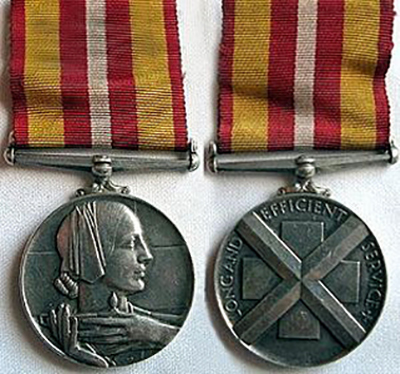 The reverse design features a St. Andrew's (Saltire) Cross superimposed over a Geneva Cross to denote the two qualifying organizations. Between the upper arms of the St Andrew's Cross is the inscription LONG AND EFFICIENT SERVICE. The original medal was made of silver and later versions of silver-plated copper and beginning in the 1960s, copper-nickel. The medal is rimmed named.
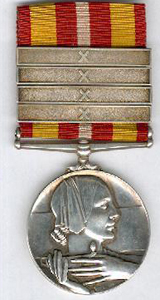
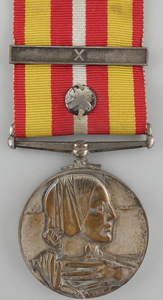
Medal Denoting 35 Years-Service with St. Andrew's left) and Medal With Silver-gilt Emblem for 35+ Years of Service (right)
Subsequent awards for each additional five-year service period are denoted by a slip-over clasp with either a Geneva Cross (Red Cross awards) or a St. Andrew's Cross.
During 1882, a group of Scottish physicians formed the St. Andrew's Ambulance Association based loosely on the much older St. John's Ambulance Brigade, which dates back to the Crusades. A main concern was the increasing rate of accidents resulting from the industrialization of the economy. The Association's first ambulance was acquired during April 1882, serving the Glasgow and surrounding area, providing both transportation of the injured, but also first aid. Four years later, the Association was manning a small fleet of six ambulances.
In 1891, the Association published the Ambulance Handbook by Dr. George Batson. The goal was to provide a concise overview for first aid treatment for various accidents and also cover issues involving casualty transportation. The book remains as the Association's bible and has been updated many times over the intervening years.
In 1899, Queen Victoria granted the Association a Royal Charter, which legally recognized the entity. During 1900, the Ambulance Association, working with the British Red Cross Society (BRCS) helped organize the Scottish National Red Cross Hospital at Kroonstadt, South Africa during the Boer War.
The Scottish National Red Cross Hospital was funded by voluntary donations. The hospital commenced operations during January 1900. The hospital staff consisted of an officer in charge, 18 civilian medical officers, one Quartermaster, one Warrant Officer, two secretaries, 35 Army Nursing Service Reserve sisters, 45 first-class orderlies, all of whom were medical students, and 57 second-class orderlies, making the total compliment of 160. The Matron was Sister E. C. Shannon, MiD.
By 1904, the organization was now known as the St. Andrew's Ambulance Corps. It consolidated all of the ambulance groups in Scotland under a uniform set of regulations. During WW I, the Corps was able to staff all of Scotland's military hospitals, freeing the regular staff for military service. The St. Andrew Ambulance Corps also staffed two foreign service units, which served in France and aboard hospital ships. A Military Nursing Service was also assembled from female members of the Corps. The traditional ambulance service worked closely with the British Red Cross Society (BRCS) attending to and transporting injured soldiers. In 1908, St. Andrew's and St. John's reached an agreement ceding England to St. John's and Scotland to St. Andrew's. Both organizations continue to enjoy a good working relationship with each other and with the BRCS.
Award Criteria
The Voluntary Medical Service Medal, instituted in 1932 and first presented by King George V, is awarded by the British Red Cross Society (BRCs) and the St. Andrew's First Aid for 15 consecutive years of efficient service as a first aid volunteer with either the BRCS or St. Andrew's with a minimum of ten hours of field service per year. Service is retroactive to 1909 and the creation of Voluntary Aid Detachments.
Medal Design
The 36mm medal was designed by Percy Metcalf. Metcalfe's Voluntary Medical Service Medal beautifully depicts the lady of the lamp, Florence Nightingale, on the obverse. A strong visual impact is created in its design by the hands and face pointing in opposite directions. According to the Mint's Advisory Committee meeting minutes from July 1, 1931, the original plan for the medal was to use a reverse design by George Kruger Gray, however it had become evident that the style would not pair satisfactorily with the obverse and Mr. Metcalfe was invited to design the reverse. Clearly Metcalfe's distinctive style did not easily blend in with the style of his contemporaries, and understandably the lady of the lamp image was the favored side of the medal.
Medal Denoting 35 Years-Service with St. Andrew's left) and Medal With Silver-gilt Emblem for 35+ Years of Service (right)
Subsequent awards for each additional five-year service period are denoted by a slip-over clasp with either a Geneva Cross (Red Cross awards) or a St. Andrew's Cross.
Website Maintained by Keith Emroll