The Russo-Japanese War (1904-1905)
The Russo-Japanese War was fought between the Russian Empire and the Empire of Japan over rival ambitions in Manchuria and Korea. Major battles were centered around the Liadong Peninsula and Mukden in southern Manchuria. Naval battles between to the two powers occurred in the seas around Japan and Korea and in the Yellow Sea.
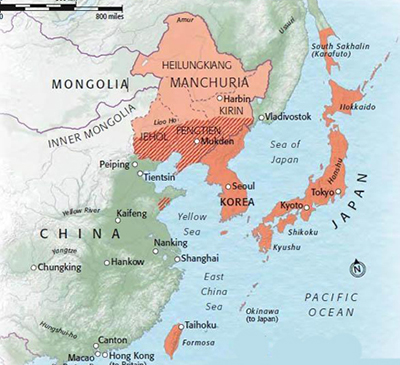
Battle Sites
Russia had no warm water Pacific ports for both military and commercial use. Japan at the time was seeking to extend its influence over both Manchuria and Korea and feared Russian encroachment would negatively influence its plans. In the face of Imperial Russia's demands for a neutral buffer zone in Korea north of the 39th parallel, Japan chose to go to war. Japan launched a surprise naval attack on the Russian Eastern Fleet at Port Arthur, China. Japan's land and naval forces proceeded to overwhelm those of Russia culminating in an embarrassing defeat for Russia and the emergence of Japan as a super power. Russia's humiliating defeat led to domestic unrest and eventually to the First Russian Revolution in 1905.
The 28mm Imperial Russian Medal for the Russo-Japanese War was instituted on January 21, 1906 during the reign of Tsar Nicholas II, to commemorate the 1904-1905 conflict between the Russian and the Japanese Empires. The silver, bronze, or copper medal was awarded to medical and clerical personnel that had been on active duty in the eastern Siberian regions adjacent to the territories declared as a war zone. The obverse depicts a triangle containing the "Eye of Providence" surrounded by rays with the inscription 1904-1905 below.
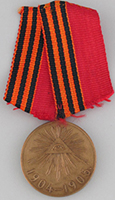
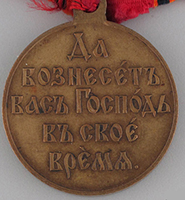
Russian Russo-Japanese War Medal in Bronze
The 30mm (golden colored) Japanese Russo-Japanese War Medal was established on March 31, 1906 by Imperial Edict No. 51 in recognition of those who served in the Russo-Japanese War during the 37th and 38th years of the Meiji period.
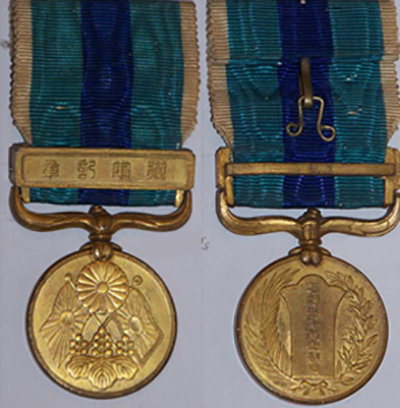
Japanese Russo-Japanese War Medal
The four characters on the clasp (JU, GUN, KI, SHO) translate as war medal. The obverse shows an Imperial Chrysanthemum above two crossed flags and paulownia leaves below (symbols of the Imperial family). The reverse inscription translated into English reads Meiji 37-8 Campaign.
The Commemorative Medal for the Squadron of Admiral Rozhdestvensky
Zinoviy Petrovich "Mad Dog" Rozhestvensky was an admiral of the Russian Imperial Navy. He commanded the Second Pacific Squadron during the Battle of Tsushima. He would face off against Admiral Togo Heiharchiro, veteran of the Battle of the Yellow Sea. With knowledge of Rozhestvensky's mission to reinforce Vladivostok, preempted the Russian plans by positioning his battle fleet to intercept that of Rozhestvensky in the most favorable position.
With only his bow guns to use, Rozhestvensky's main batteries were "thrown successively out of bearing" as he continued to advance. Other than surrender or retreat, Rozhestvensky had but two choices; fight a pitched battle or charge Togo's battleline. He chose the former, and by the evening of May 27, 1905, Rozhestvensky's flagship and the majority of his fleet were on the bottom of the Tsushima Straits. The Russians had lost 5,000 sailors. Rozhestvensky, himself, suffered a head wound from a shell fragment during the engagement.
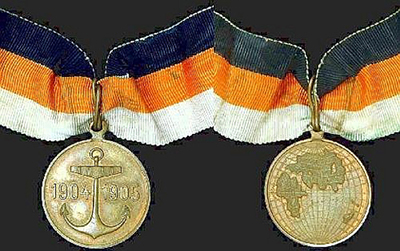 The 30mm copper medal was established February 19, 1907 by the Imperial Order of Nicholas II and declared by Marine Ministry Order No. 199 on August 30, 1907. The obverse depicts an anchor and the dates 1904 and 1905. The reverse is a tribute to Rozhestvensky's record breaking journey, sailing half way around the world from the Baltic Sea to the Pacific via the Cape Route over a seven-month period. Copies of the medal exist.
The Russo-Japanese War was fought between the Russian Empire and the Empire of Japan over rival ambitions in Manchuria and Korea. Major battles were centered around the Liadong Peninsula and Mukden in southern Manchuria. Naval battles between to the two powers occurred in the seas around Japan and Korea and in the Yellow Sea.
Battle Sites
Russia had no warm water Pacific ports for both military and commercial use. Japan at the time was seeking to extend its influence over both Manchuria and Korea and feared Russian encroachment would negatively influence its plans. In the face of Imperial Russia's demands for a neutral buffer zone in Korea north of the 39th parallel, Japan chose to go to war. Japan launched a surprise naval attack on the Russian Eastern Fleet at Port Arthur, China. Japan's land and naval forces proceeded to overwhelm those of Russia culminating in an embarrassing defeat for Russia and the emergence of Japan as a super power. Russia's humiliating defeat led to domestic unrest and eventually to the First Russian Revolution in 1905.
The 28mm Imperial Russian Medal for the Russo-Japanese War was instituted on January 21, 1906 during the reign of Tsar Nicholas II, to commemorate the 1904-1905 conflict between the Russian and the Japanese Empires. The silver, bronze, or copper medal was awarded to medical and clerical personnel that had been on active duty in the eastern Siberian regions adjacent to the territories declared as a war zone. The obverse depicts a triangle containing the "Eye of Providence" surrounded by rays with the inscription 1904-1905 below.
Russian Russo-Japanese War Medal in Bronze
The 30mm (golden colored) Japanese Russo-Japanese War Medal was established on March 31, 1906 by Imperial Edict No. 51 in recognition of those who served in the Russo-Japanese War during the 37th and 38th years of the Meiji period.
Japanese Russo-Japanese War Medal
The four characters on the clasp (JU, GUN, KI, SHO) translate as war medal. The obverse shows an Imperial Chrysanthemum above two crossed flags and paulownia leaves below (symbols of the Imperial family). The reverse inscription translated into English reads Meiji 37-8 Campaign.
The Commemorative Medal for the Squadron of Admiral Rozhdestvensky
Zinoviy Petrovich "Mad Dog" Rozhestvensky was an admiral of the Russian Imperial Navy. He commanded the Second Pacific Squadron during the Battle of Tsushima. He would face off against Admiral Togo Heiharchiro, veteran of the Battle of the Yellow Sea. With knowledge of Rozhestvensky's mission to reinforce Vladivostok, preempted the Russian plans by positioning his battle fleet to intercept that of Rozhestvensky in the most favorable position.
With only his bow guns to use, Rozhestvensky's main batteries were "thrown successively out of bearing" as he continued to advance. Other than surrender or retreat, Rozhestvensky had but two choices; fight a pitched battle or charge Togo's battleline. He chose the former, and by the evening of May 27, 1905, Rozhestvensky's flagship and the majority of his fleet were on the bottom of the Tsushima Straits. The Russians had lost 5,000 sailors. Rozhestvensky, himself, suffered a head wound from a shell fragment during the engagement.
Website Maintained by Keith Emroll