Medals of Gallipoli
The Ottoman War Medal
The Ottoman or Turkish War Medal (also referred to as the Turkish Star, Turkish Gallipoli Star, Iron Crescent or Iron Half Moon) was a military gallantry decoration awarded by the Ottoman Empire. It was instituted by Sultan Mehmed V Resad on March 1, 1915 for gallantry in battle. This decoration was awarded for the duration of World War I to Ottoman and other Central Powers troops, primarily in the Ottoman areas of engagement.
The award includes a badge, ribbon and campaign bar. The medal, made of nickel-plated brass, has a vaulted star-shaped badge, 56mm across the diagonal span of the arms. The tips of the star are capped by finial balls and enclosed in a raised silver edge with the field in red lacquer or enamel. A raised crescent, open at the top, encircles the center of the badge. Inside the crescent is the tughra or cipher of the decoration's creator, Sultan Mehmed V Resad, over the date 1333 AH (AD 1915). It was authorized for award by the Commander-in-Chief of the Ottoman military, Enver Pasha. The reverse is flat and has a straight pin. The medal was issued in two versions – for officers and other ranks. The former was made of silvered brass with red enamel while the latter was made of white metal with thin red lacquer. Nevertheless any recipient had an opportunity to purchase a fine copy of the award from numerous German jewelers, who continued producing medals during WWI and Weimar Republic-era.
The badge came with a ribbon with red and white stripes. The dimensions of the ribbon for combatants are: red 2.5mm; white, 5mm.; red, 29mm.; white, 5mm.; red 2.5mm. For non-combatant awardees, the colors are reversed. Campaign bars, designed to be worn on the ribbon drape, were a right-pointing, 56mm by 7mm, white parabola. Red Arabic script denoted one of five specific campaigns: (1) CHANAKKALE/CHANAK (Gallipoli); (2) GAZA; (3) KANAL; (4) KUT-AL-AMARA or (5) SANATORIUM.
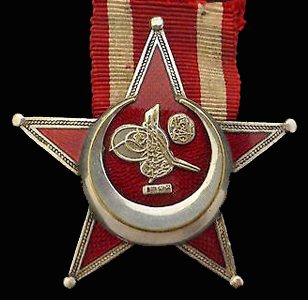
Gallipoli Star on Combatant's Ribbon
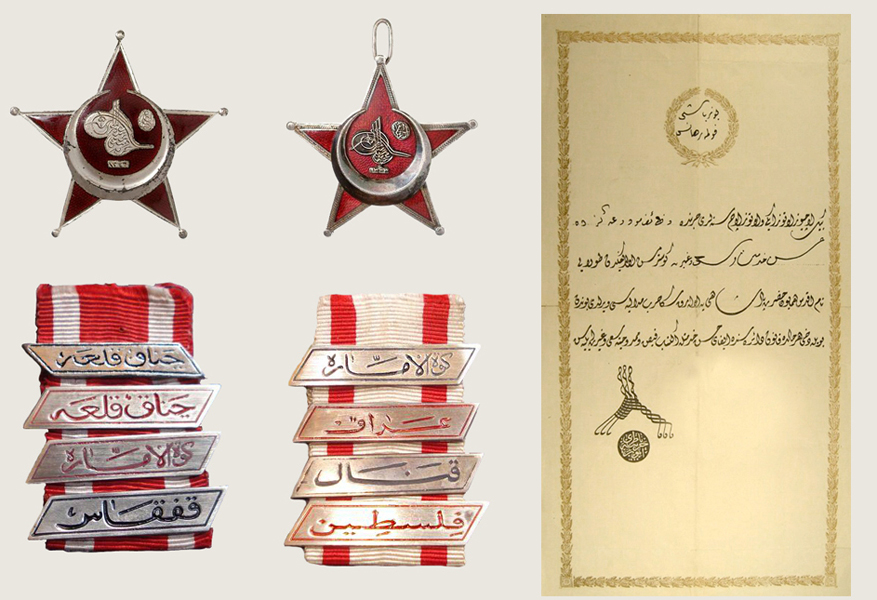
Gallipoli Star with Enamel (left) and with Paint (right), Award Certificate and Campaign Badges on Combatant and Non-Combatant Ribbons
French Commemorative Medal for the Orient and Dardanelles
The Dardanelles campaign medal was a French military medal bestowed for participation in the Battle of the Dardanelles, also known as the Gallipoli Campaign against the Central Powers by the Corps Expeditionnaire d'Orient, supported by the Royal Navy and French Navy between April 25, 1915 and January 9, 1916.
The 30mm in diameter circular French Commemorative Medal for the Orient and Dardanelles was struck from bronze. The obverse bears the relief image of the Republic in the form of the left profile, helmeted woman's bust, the helmet being adorned by a crown of oak leaves. On either side, the relief inscription along the circumference REPUBLIQUE FRANCAISE.
The reverse, representing both the army and navy, bears the relief image of an infantry rifle crossed with a naval anchor below two military banners and lances surmounted by the relief inscription DARDANELLES. On some variants, the relief inscription reads, HONNEUR ET PATRIE 1915 1918 and can be found on one of the banners. Other variants lack the anchor. A second reverse replaces the inscription DARDANELLES with ORIENT.
The medal hangs from a ribbon through a ring passing through the medal's suspension loop. The ring is adorned by a 24mm in diameter bronze laurel wreath and half crescent. An unofficial gilt clasp with oriental ornamentation bearing the inscription DARDANELLES is sometimes worn on the ribbon.
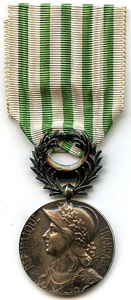
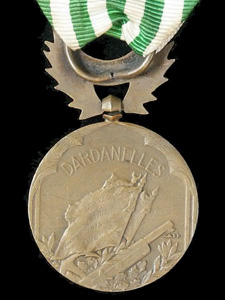
French Commemorative Medal for the Dardanelles Obverse & Reverse
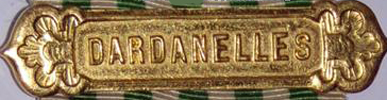
Unofficial Clasp
Great Britain
Sadly, Great Britain did not issue a specific Gallipoli medal. Instead participants received a trio of medals: 1914/15 Star, British War Medal and the WW I Victory medal. This has not hindered private profiteers from issuing all sorts of unofficial Gallipoli badges, gongs & buttons.
1914-1915 Star
This bronze medal was authorized in 1918. It is very similar to the 1914 Star but it was issued to a much wider range of recipients. Broadly speaking it was awarded to all who served in any theatre of war against Germany between August 5, 1914 and December 31, 1915, except those eligible for the 1914 Star. Similarly, those who received the Africa General Service Medal or the Sudan 1910 Medal were not eligible for the award.
The medal is a four pointed star of bright bronze, unsigned with a crown, with a height of 50 mm, and a maximum width of 45mm. Obverse has two crossed glade (swords) with blades upwards and a wreath of oak leaves, with the royal cipher of King George V at its base and an overlaying central scroll inscribed 1914-15. The reverse is plain with the recipient’s number, rank and name.
Like the 1914 Star, the 1914-15 Star was not awarded alone. The recipient had to have received the British War Medal and the Victory Medal. An estimated 2.4 million of these medals were issued.
The British War Medal
The silver or bronze medal was awarded to officers and men of the British and Imperial Forces who either entered a theatre of war or entered service overseas between 5th August 1914 and 11th November 1918 inclusive. This was later extended to services in Russia, Siberia, and some other areas in 1919 and 1920.
Approximately 6.5 million British War Medals were issued. Approximately 6.4 million of these were the silver versions of this medal. Around 110,000 of a bronze version were issued mainly to Chinese, Maltese and Indian Labor Corps troops. The obverse of the medal depicts the bust of George V with the Latin inscription, GEORGIVS V BRIT: OMN; REX ET IND: IMP. The reverse features a naked horseman with short sword trampling an eagle shield, representative of the Central Powers. Below is a skull & crossbones representing death and above, the rising sun, representing victory. The curved years 1914 and 1918 frame the rider.
Allied Victory Medal
It was decided that each of the allies should each issue their own bronze victory medal with a similar design, similar equivalent wording and identical ribbon. The British medal was designed by W. McMillan. The obverse depicts the winged, full-length, full-front, figure of Victory with her left arm extended and holding a palm branch in her right hand. The reverse contains a four-line inscription, THE GREAT / WAR FOR / CIVILISATION / 1914-1919, surrounded by a laurel wreath.
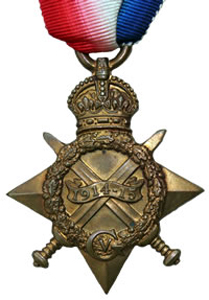

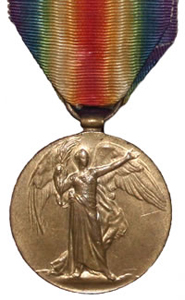
1914/15 Star, British War Medal & Allied Victory Medal
Gallipoli Star
Originally to have been called the ANZAC Star, the award was proposed by Lieutenant General William Birdwood (1865-1951) for award to Australian and New Zealand troops who served at Gallipoli. The medal was designed by R. K. Peacock. It was an eight-pointed bronze star (representing New Zealand and the seven territories of Australia) with a central silver disc. On the disc is the circular inscription, GALLIPOLI 1914-15, surrounding a royal crown. Despite approval by George V, protests, over a medal not intended for award to other Commonwealth troops, who took part in the operation and constituted a majority of deployed troops, were raised by the British parliamentarians and the media. In 1918, after ribbons, but not the medals, had been shipped to the two nations, the award was cancelled. Instead eligible soldiers of all Commonwealth nations were awarded the 1914 – 1915 Star (see above).
In 1967, an ANZAC Commemorative Medallion/Table Medal and an ANZAC Commemorative Lapel Badge for surviving veterans of Gallipoli were authorized. The table medal could also be applied for by the next of kin of deceased Gallipoli veterans.
The modern Gallipoli Star is a military decoration never awarded but later privately struck as commemorative. Conceived by a retired Australian Warrant Officer, Ross Smith, approximately 2,000 Gallipoli Stars were commissioned from a professional medal manufacturer. Of this total, 200 Stars were to be presented to survivors of the battles for the 75th anniversary of Gallipoli in 1990. The balance - about 1,800 - were sold to collectors to offset production costs. When word spread, New Zealand also jumped on the concept and utilized their own manufacturer. The numbers of this unofficial medal created by New Zealand are unknown.

1990 Unofficial ANZAC/Gallipoli Star
The Ottoman War Medal
The Ottoman or Turkish War Medal (also referred to as the Turkish Star, Turkish Gallipoli Star, Iron Crescent or Iron Half Moon) was a military gallantry decoration awarded by the Ottoman Empire. It was instituted by Sultan Mehmed V Resad on March 1, 1915 for gallantry in battle. This decoration was awarded for the duration of World War I to Ottoman and other Central Powers troops, primarily in the Ottoman areas of engagement.
The award includes a badge, ribbon and campaign bar. The medal, made of nickel-plated brass, has a vaulted star-shaped badge, 56mm across the diagonal span of the arms. The tips of the star are capped by finial balls and enclosed in a raised silver edge with the field in red lacquer or enamel. A raised crescent, open at the top, encircles the center of the badge. Inside the crescent is the tughra or cipher of the decoration's creator, Sultan Mehmed V Resad, over the date 1333 AH (AD 1915). It was authorized for award by the Commander-in-Chief of the Ottoman military, Enver Pasha. The reverse is flat and has a straight pin. The medal was issued in two versions – for officers and other ranks. The former was made of silvered brass with red enamel while the latter was made of white metal with thin red lacquer. Nevertheless any recipient had an opportunity to purchase a fine copy of the award from numerous German jewelers, who continued producing medals during WWI and Weimar Republic-era.
The badge came with a ribbon with red and white stripes. The dimensions of the ribbon for combatants are: red 2.5mm; white, 5mm.; red, 29mm.; white, 5mm.; red 2.5mm. For non-combatant awardees, the colors are reversed. Campaign bars, designed to be worn on the ribbon drape, were a right-pointing, 56mm by 7mm, white parabola. Red Arabic script denoted one of five specific campaigns: (1) CHANAKKALE/CHANAK (Gallipoli); (2) GAZA; (3) KANAL; (4) KUT-AL-AMARA or (5) SANATORIUM.
Gallipoli Star on Combatant's Ribbon
Gallipoli Star with Enamel (left) and with Paint (right), Award Certificate and Campaign Badges on Combatant and Non-Combatant Ribbons
French Commemorative Medal for the Orient and Dardanelles
The Dardanelles campaign medal was a French military medal bestowed for participation in the Battle of the Dardanelles, also known as the Gallipoli Campaign against the Central Powers by the Corps Expeditionnaire d'Orient, supported by the Royal Navy and French Navy between April 25, 1915 and January 9, 1916.
The 30mm in diameter circular French Commemorative Medal for the Orient and Dardanelles was struck from bronze. The obverse bears the relief image of the Republic in the form of the left profile, helmeted woman's bust, the helmet being adorned by a crown of oak leaves. On either side, the relief inscription along the circumference REPUBLIQUE FRANCAISE.
The reverse, representing both the army and navy, bears the relief image of an infantry rifle crossed with a naval anchor below two military banners and lances surmounted by the relief inscription DARDANELLES. On some variants, the relief inscription reads, HONNEUR ET PATRIE 1915 1918 and can be found on one of the banners. Other variants lack the anchor. A second reverse replaces the inscription DARDANELLES with ORIENT.
The medal hangs from a ribbon through a ring passing through the medal's suspension loop. The ring is adorned by a 24mm in diameter bronze laurel wreath and half crescent. An unofficial gilt clasp with oriental ornamentation bearing the inscription DARDANELLES is sometimes worn on the ribbon.
French Commemorative Medal for the Dardanelles Obverse & Reverse
Unofficial Clasp
Great Britain
Sadly, Great Britain did not issue a specific Gallipoli medal. Instead participants received a trio of medals: 1914/15 Star, British War Medal and the WW I Victory medal. This has not hindered private profiteers from issuing all sorts of unofficial Gallipoli badges, gongs & buttons.
1914-1915 Star
This bronze medal was authorized in 1918. It is very similar to the 1914 Star but it was issued to a much wider range of recipients. Broadly speaking it was awarded to all who served in any theatre of war against Germany between August 5, 1914 and December 31, 1915, except those eligible for the 1914 Star. Similarly, those who received the Africa General Service Medal or the Sudan 1910 Medal were not eligible for the award.
The medal is a four pointed star of bright bronze, unsigned with a crown, with a height of 50 mm, and a maximum width of 45mm. Obverse has two crossed glade (swords) with blades upwards and a wreath of oak leaves, with the royal cipher of King George V at its base and an overlaying central scroll inscribed 1914-15. The reverse is plain with the recipient’s number, rank and name.
Like the 1914 Star, the 1914-15 Star was not awarded alone. The recipient had to have received the British War Medal and the Victory Medal. An estimated 2.4 million of these medals were issued.
The British War Medal
The silver or bronze medal was awarded to officers and men of the British and Imperial Forces who either entered a theatre of war or entered service overseas between 5th August 1914 and 11th November 1918 inclusive. This was later extended to services in Russia, Siberia, and some other areas in 1919 and 1920.
Approximately 6.5 million British War Medals were issued. Approximately 6.4 million of these were the silver versions of this medal. Around 110,000 of a bronze version were issued mainly to Chinese, Maltese and Indian Labor Corps troops. The obverse of the medal depicts the bust of George V with the Latin inscription, GEORGIVS V BRIT: OMN; REX ET IND: IMP. The reverse features a naked horseman with short sword trampling an eagle shield, representative of the Central Powers. Below is a skull & crossbones representing death and above, the rising sun, representing victory. The curved years 1914 and 1918 frame the rider.
Allied Victory Medal
It was decided that each of the allies should each issue their own bronze victory medal with a similar design, similar equivalent wording and identical ribbon. The British medal was designed by W. McMillan. The obverse depicts the winged, full-length, full-front, figure of Victory with her left arm extended and holding a palm branch in her right hand. The reverse contains a four-line inscription, THE GREAT / WAR FOR / CIVILISATION / 1914-1919, surrounded by a laurel wreath.
1914/15 Star, British War Medal & Allied Victory Medal
Gallipoli Star
Originally to have been called the ANZAC Star, the award was proposed by Lieutenant General William Birdwood (1865-1951) for award to Australian and New Zealand troops who served at Gallipoli. The medal was designed by R. K. Peacock. It was an eight-pointed bronze star (representing New Zealand and the seven territories of Australia) with a central silver disc. On the disc is the circular inscription, GALLIPOLI 1914-15, surrounding a royal crown. Despite approval by George V, protests, over a medal not intended for award to other Commonwealth troops, who took part in the operation and constituted a majority of deployed troops, were raised by the British parliamentarians and the media. In 1918, after ribbons, but not the medals, had been shipped to the two nations, the award was cancelled. Instead eligible soldiers of all Commonwealth nations were awarded the 1914 – 1915 Star (see above).
In 1967, an ANZAC Commemorative Medallion/Table Medal and an ANZAC Commemorative Lapel Badge for surviving veterans of Gallipoli were authorized. The table medal could also be applied for by the next of kin of deceased Gallipoli veterans.
The modern Gallipoli Star is a military decoration never awarded but later privately struck as commemorative. Conceived by a retired Australian Warrant Officer, Ross Smith, approximately 2,000 Gallipoli Stars were commissioned from a professional medal manufacturer. Of this total, 200 Stars were to be presented to survivors of the battles for the 75th anniversary of Gallipoli in 1990. The balance - about 1,800 - were sold to collectors to offset production costs. When word spread, New Zealand also jumped on the concept and utilized their own manufacturer. The numbers of this unofficial medal created by New Zealand are unknown.
1990 Unofficial ANZAC/Gallipoli Star
Website Maintained by Vaudezilla