NAVAL CAMPAIGN
BATTLE of IQUIQUE In 1879, the Bolivian authorities seized some property of the Chilean Nitrate Company in Antofagasta, which at the time was a part of the Bolivian province of Atacama. This brought about a war in which Peru sided with Bolivia. It was known as the War of the Pacific, or the Nitrate War. At its close Chile took possession of the entire Bolivian seacoast (the provinces of Tacna and Arica) and the Peruvian province of Tarapaca.
The Chilean Navy and its battleships—Almirante Cochrane and Blanco Encalada—started to operate on the Bolivian and Peruvian coast. The port of Iquique was blockaded, while Huanillos, Mollendo, Pica, and Pisagua were bombarded and port facilities burned. Rear Admiral Juan Williams Robolledo hoped that, by disrupting commerce and especially saltpeter exports and weapon imports, the Allies' war effort would be weakened and the Peruvian Navy would be forced into a decisive showdown.
The smaller, but effective, Peruvian Navy did not oblige. Under the command of Admiral Miguel Grau Seminario aboard Huascar, Peru staged a series of blockade runs and harassment raids deep into Chilean waters. The plan was to disrupt Chilean operations, draw the enemy fleet back to the South while avoiding at all costs a fight against superior forces. As a further consequence, the Chilean invasion would be delayed, the Allies would be free to supply and reinforce their troops along the coast, and weapons would still flow into Peru from the North.
At the famous Naval Battle of Iquique of May 21, 1879, Peruvian ships Huascar and Independencia lifted the blockade of Iquique by the Esmeralda and Covadonga, two of Chile's oldest wooden vessels. Huascar sank Esmeralda, while Covadonga forced the larger Independencia to run aground at Punta Gruesa (some historians consider this a different engagement calling it the Battle of Punta Gruesa).
For six months afterwards, the Huascar roamed the seas and effectively cut off the Chilean supply lines. In an impressive display of naval mastery, Admiral Miguel Maria Grau Seminario, the most renowned Peruvian Naval officer, was able to hold off the entire Chilean Navy, recover captured Peruvian vessels and severely damage many ports used by the Chilean Navy.
It took the Chilean Navy a full day of sailing with six ships in order to corner the Huascar, and then, nearly two hours of bloody combat with their vessels Blanco Encalada, Covadonga, and Cochrane to cause her to founder with 76 artillery hits in the great Naval Battle of Angamos on October 8, 1879. The dead included Admiral Grau. With the capture of Huascar, the naval campaign was over, with the exception of local skirmishes, Chile would control the sea for the duration of the war.
LAND CAMPAIGN
Having gained control of the sea, the Chilean Army started the invasion of Peru. Bolivia, unable to recover the Litoral Province (southwestern Bolivia), joined the Peruvian defense of Tarapaca and Tacna. However, many Bolivians would abandon their allies in the heat of the battle, demoralizing both armies.
On November 2, 1879, naval bombardment and amphibious assaults were carried out at the small port of Pisagua and the Junín Cove –some 500 km North of Antofagasta. At Pisagua, several landing waves totaling 2,100 troops attacked beach defenses held by 1,160 Allies and eventually took the town. The landing at Junín was smaller and almost unsuccessful. By the end of the day, General Erasmo Escala and a Chilean army of 10,000 were ashore and moving inland, isolating the province of Tarapaca from the rest of Peru and cutting off any reinforcements for General Juan Buendía’s 1st Southern Army.
Marching south towards the city of Iquique with 6,000 troops, the Chilean Army held off a sudden 7,400 men-strong Allied counterattack at the Battle of San Francisco on November 19, 1980 with high casualties to both sides. The Bolivian force with a weak leadership withdrew during the battle, forcing the Peruvian Army to retreat to the city of Tarapaca. Four days later, the Chilean Army captured Iquique with little resistance.
Escala sent a detachment of 3,600 soldiers, cavalry, and artillery to wipe out the rest of the Peruvian Army, estimated at fewer than 2,000 poorly trained and demoralized men. The Battle of Tarapaca, took place on November 27, 1880 with the attacking Chilean Army discovering the Peruvian force in better morale and at almost double the number expected. Led by Colonel Andrés Caceres, the Peruvian Army routed the Chilean expedition, which left behind significant quantities of supplies and ammunition. The Peruvian victory at Tarapaca would have little impact on the war. General Juan Buendia Noriego's army, with 4,000 troops remaining, retreated further north to Arica.
A new Chilean expedition left Pisagua and on February 24, 1880, disembarked nearly 12,000 soldiers at Pacocha Bay. Commanded by General Manuel Baquedano, this force isolated the provinces of Tacna and Arica destroying any practical hope for reinforcements from Peru. On the outskirts of Tacna, combatants from the three contending countries met on what would later be known as The Battle of El Alto de la Alianza. Commanding the allied army was Narciso Campero, the Bolivian president himself. In the subsequent carnage, Chilean artillery proved superior. As a result, Chile wiped out most of Peru's professional army. Following this battle, Bolivia withdrew completely from the war.
At the Battle of Arica, which turned out to be one of the most tragic and at the same time the most emblematic event of the war, Chile suffered 479 fatalities, while almost 900 Peruvians lost their lives, including Colonel Francisco Bolognesi Cervantes. This battle was especially bloody since most Chileans died because of landmines and with bullets running low most of the Peruvians deaths were at the hands of corvo wielding (curved bladed weapon used in Chile) berserk Chileans. The multiple cuts on the corpses made many speculate about execution of prisoners, but most authors say that the Chilean field officers were actually holding back the enraged Chileans to prevent the deaths of the routed Peruvian soldiers.
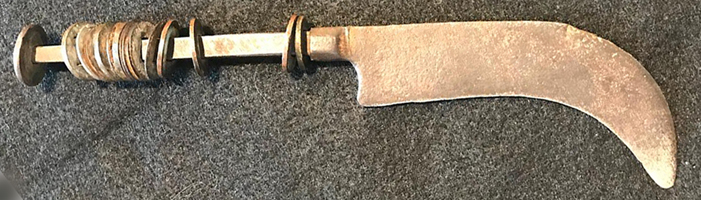
The Chilean Corvo
Peruvian resistance continued for three more years, with apparent U.S. encouragement. The leader of the resistance was General Andrés Caceres (nicknamed the "Warlock of the Andes"), who would later be elected president of Peru. Under his intelligent lead, Peruvian militia forces inflicted painful defeats upon the Chilean army in the battles of Pucara, Marcavalle and Concepcion. However, after a substantial defeat at the Battle of Huamachuco, there was little further resistance. Finally, on October 20, 1883, Peru and Chile signed the Treaty of Ancon, by which Tarapaca province was ceded to the victor. For its part in the war, Bolivia was forced to cede the province of Antofagasta to the Chileans.
OUTCOME
Under the terms of the Treaty of Ancon, Chile occupied the provinces of Tacna and Arica for 10 years, after which a plebiscite was to be held to determine their nationality. The two countries failed for decades to agree on the terms of the plebiscite. Finally in 1929, through the mediation of the United States under President Herbert Hoover, an accord was reached by which Chile kept Arica; Peru reacquired Tacna and received $6 million indemnity and other concessions.
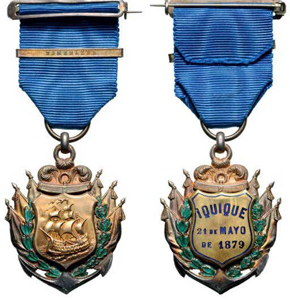
NAVAL MEDAL for IQUIQUE with BAR ESMERALDA

BAR ESMERALDA

BAR CAVADONGA
In 1884, Bolivia signed a truce that gave control to Chile of the entire Bolivian coast, the province of Antofagasta, and its valuable nitrate, copper and other mineral deposits. A treaty, in 1904, made this arrangement permanent. In return, Chile agreed to build a railroad connecting the Bolivian capital of La Paz with the port of Arica and guaranteed freedom of transit for Bolivian commerce through Chilean ports and territory.
NAVAL MEDAL for IQUIQUE To reward their seamen, Chile, by a decree of September 12, 1879, authorized this medal in gold or silver, in the form of a shield framed in green-enameled laurel branches, bearing on the obverse a vessel, the whole being superimposed on an anchor and flanked by flags. On the reverse is, IQUIQUE 21 DE MAYO DE 1879. The ribbon is dark blue, displaying one or more of the following bars: ESMERALDA, CAVADONGA (the ship, which destroyed the Peruvian Huascar) or ARICA for an engagement on November 28, ten days after the Battle of San Francisco, when Chile declared a formal blockade of Arica. A total of 48 medals were awarded.
CITY of SANTIAGO MEDAL for IQUIQUE Santiago City also issued a medal for this engagement. It is a 24 mm circular silver medal. The obverse depicts the Esmeralda. The legend reads, EL PUEBLO DE SANTIAGO A LOS HEROES DE IQUIQUE. The reverse is inscribed within a circle of laurel branches, 21 DE MAYO DE 1879. The ribbon is equal parts red, blue and white.
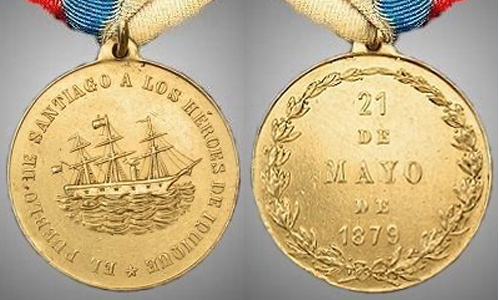
CITY of SANTIAGO NAVAL MEDAL for IQUIQUE
NAVAL MEDAL HOMAGE to the HEROES This round variant, honoring the heroes of the naval battle at Iquique, features the Esmeralda in battle on the obverse. Above is a scroll, which reads, IQUIQUE and below is the date, 21 DE MAYO 1879. The otherwise plain reverse is inscribed, HOMAGE A LOS HEROES. A third and fourth variant, in two sizes 34 mm and 28 mm, depicts the two ships in combat on the obverse with the Latin numerals, XXI V MDCCCLIX (21 May 1879) and COMBATE NAVAL IQUIQUE below. The reverse features winged-victory, arms spread, with GLORIA above and A LA MARINA CHILENA in the lower portion. The ribbon is equal parts red, blue and white.
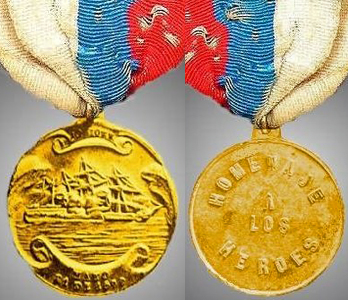
NAVAL HOMAGE to the HEROES MEDAL for IQUIQUE VARIANT 1
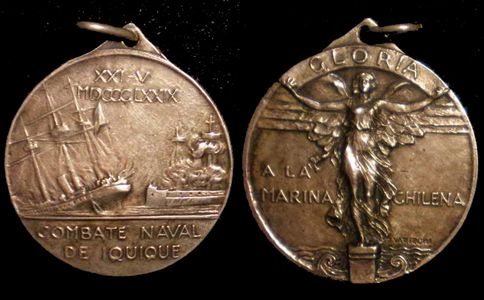
MEDAL for IQUIQUE (Bronze) 28 mm VARIANT 3
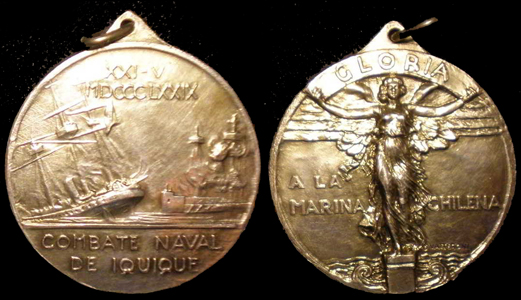
MEDAL for IQUIQUE (Bronze) 34 mm VARIANT 4
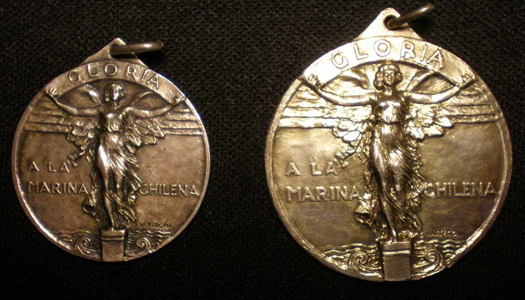
ILLUSTRAION of COMPARATIVE SIZE DIFFERENCES
CROSS for TARAPACA 1879 The cross was awarded for service in the first land battle near Pisagua, Tarapaca, Peru, which occurred November 27, 1879. The decoration is a gold star of six double-pointed red-enamel arms with rays in the angles. The obverse medallion is inscribed, TARAPACA. The reverse medallion is inscribed, 27 DE NOVIEMBRE DE 1879. The ribbon is red with a white stripe in the center. It would appear that the model on the left with red-enameled arms and the green-enamel wreath suspension was reserved for senior officers.
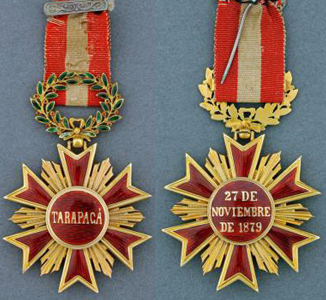
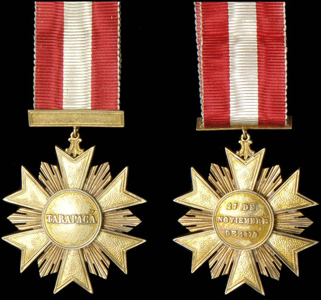
CROSSES for TARAPACA 1879
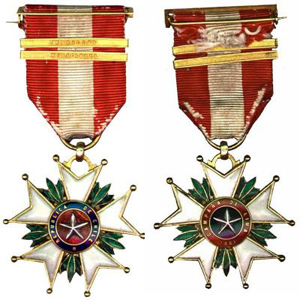
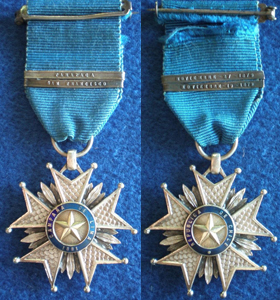
GOLD CROSS 1879-1880 and SILVER CROSS for the LIMA CAMPAIGN 1880- 1881
CROSSES for CAMPAIGN OF LIMA 1881 The Lima campaign started in November 1880, under the leadership of General Manuel Baquedano. By January 18, 1881, Lima and Callao had surrendered. The cross was created by a law of January 14, 1882.
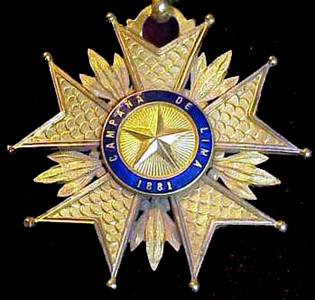
LIMA CAMPAIGN 1880-1881 GOLD CROSS
The gold cross is a 44 mm white-enamel double pointed five-armed cross with finial ball tips. There are three green-enamel laurel leaves between each arm. Both the obverse and reverse of the gold cross depict a five-pointed, silver star encircled by a blue (obverse) or red (reverse) enamel band. The obverse is inscribed, CAMPANA DE LIMA 1881 and the reverse is inscribed, REPUBLICA DE CHILE.
The 42 mm silver five-armed cross with finial balls and scaled details on the arms presents three silver laurel leaves in each quadrant. The center obverse depicts a five-pointed star surrounded by an enameled blue border with the inscription, CAMPANA DE LIMA 1881. The reverse features a similar star also surrounded by a blue-enamel border inscribed, REPUBLICA DE CHILE.
Bars apply equally to both grades of the Lima Campaign Medal and are attached to the ribbon drape for the following engagements: (1) SAN FRANCISCO (Nov. 19–1880); (2) TARAPACA (Nov. 27–1880); (3) CHORILLOS (Jan. 13–1881); (4) MIRAFLORES (Jan. 15–1881) and (5) ANGAMOS (Oct. 8 -1879) The location name appears on the front of the bar and the corresponding date on the reverse.
MEDAL of VALPARAISO 1879-81 The 49 x 30 mm silver medal was given by the city of Valparaiso to its various troops serving in the war with Peru and Bolivia during 1879–1881. It is a gold or silver medal framed in laurel leaves and having a condor with spread wings as the suspension device. Within the wreath is a blue-enameled band inscribed VALPARAISO A SUS VALIENTES, encircling the arms of that city, which consist of a background of rays surrounding an anchor surmounted by a crown formed of ships' sails and on the anchor, there is a shield bearing a two-funneled ship and with a star above. The reverse is inscribed within a laurel wreath, REGIMENTO VALPARAISO around a small five-pointed star, and outside of the wreath, CAMPANA CONTRA EL PERU Y BOLIVIA 1879-1881. Available bars are: MIRAFLORES and CHORILLOS. Variants exist with: (1) BATTALON DE CIVICO DE ARTILLERIA NAVEL and (2) VALPARAISO BATTALON reverses.
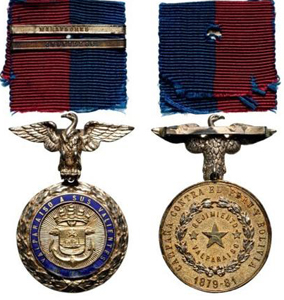
CITY of VALPARAISO MEDAL to the BRAVE VAPARAISO REGIMENT 1879-81
MEDAL for MIRAFLORES 1881 In Quillota, during the 1860s there existed a Mobilized Civic Battalion Quillota. During the War of the Pacific, members of this battalion were authorized to carry arms and during August 1880, they were sent to support to the Chilean Army in the Battle of Miraflores.
Among the ranks of the Quillotanos were the commanders: Jose Ramon Echeverria Castro, Figueroa Brito and Pragmacio Vial. The city awarded its men with a silver medal from the City of Quillota (one of the oldest cities of Chile) in recognition of their heroic actions. The 24 mm medal is of white metal, inscribed on the obverse, QUILLOTA A SUS HIJOS on four straight lines and on the reverse, within laurel branches surmounted by a small five-armed star, MIRAFLORES ENERO 15 1881. The correct ribbon is solid blue.
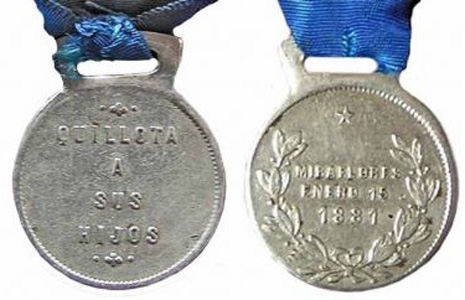
MEDAL for MIRAFLORES 1881
MEDAL for ANGAMOS AKA the NAVAL CAMPAIGN MEDAL of 1879-80-81 The obverse of this 36 mm silvered-zinc medal bears the bust of General Manuel Baquedano, framed by laurel branches, encircled by the inscription, AL EJERCITO Y ESCUADRA above and EL PUEBLO CHILENO below. The medal is signed V. Prinz below the bust on the obverse. The reverse depicts a scene of naval combat, encircled by the inscription, RECUERDO DE LA CAMPANA 1879–80–1881.
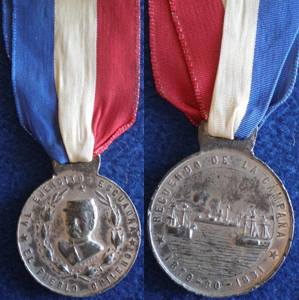
MEDAL for ANGAMOS AKA the NAVAL CAMPAIGN MEDAL of 1879-80-81
The Battle of Angamos was a naval encounter of the War of the Pacific fought between the navies of Chile and Peru at Punta Angamos, on October 8, 1879. The battle was the culminating point of a naval campaign that lasted about five months in which the Chilean Navy had the sole mission of eliminating its Peruvian counterpart. In the struggle, two armored frigates, led by Commodore Galvarino Riveros and Navy Captain Juan Jose Latorre battered and later captured the Peruvian monitor Huascar under Rear Admiral Miguel Grau Seminario.
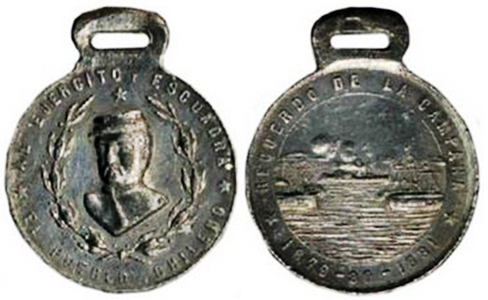
MEDAL for ANGAMOS (Detail)
After the loss of the frigate Independencia at Punta Gruesa, Grau sought to challenge the outnumbered Chilean fleet by adopting a harassing strategy, focused on inflicting as much damage as possible while avoiding a full scale engagement. As Grau evolved along the Pacific coast, he was chased by Admiral John Williams Rebolledo, who had been ordered to catch Grau. His failure cost him his commission, and he was replaced by Riveros.
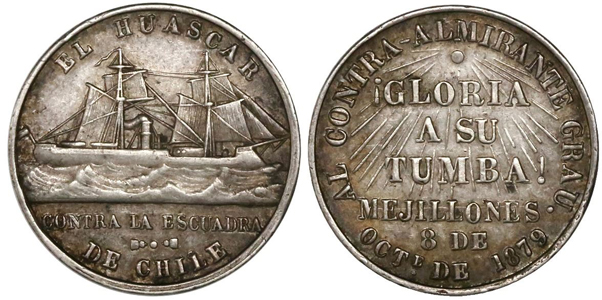
ANGAMOS COMMEMORATIVE MEDAL
With a different strategy, Riveros managed to encircle Grau at Punta Angamos, about 80 kilometers north of Antofagasta. Falling into a trap set by Riveros and Latorre, Grau was forced to engage the Chileans, after ordering the corvette Unión to escape to Peru. Latorre, aboard Almirante Cochrane, engaged first. Taking advantage of the powerful Armstrong-type batteries, Latorre shelled Huascar for almost two hours, and Grau was killed in the action. However, his flagship continued the fight while Riveros engaged her with the Blanco Encalada. After being battered for almost three hours, the Huascar, unable to sustain combat, was boarded and captured.
The result was a complete success for the Chilean Navy, and secured its dominant naval position for the rest of the war. It allowed Chile to prepare for the invasion of the Tarapaca Department, carried out during early November. The Chilean Navy’s dominance of the Pacific coast contributed significantly to success in the following land campaigns across the Atacama Desert that ended with Lima's fall on January 1881. The Huascar was repaired and served under the Chilean flag until its decommission, and now serves as a floating museum in the port of Talcahuano.
ANGAMOS COMMEMORATIVE This is a silver medal, 1879 from the War of the Pacific commemorating the battle with the Peruvian ship, El Huascar. The Battle of Angamos on Oct. 8, 1879, ended in a decisive naval victory when a Chilean squadron of ships finally caught up to the Huascar, a Peruvian ironclad which had been conducting harassing attacks on Chilean vessels. After almost three hours of battle, the Huascar, with its turret damaged, stern set aflame, rudder shot out, and commander Rear Admiral Miguel Grau killed, was boarded and captured. The Huascar is now a museum ship berthed in Talcahuano, Chile, and dedicated to the glory of both the Chilean and Peruvian navies.
The obverse features an image of the El Huascar and the inscription, EL HUASCAR CONTRA EL ESCAUDRA DE CHILE. The reverse reads, AL CONTRA ALMIRANTE GRAU curved around the upper edge and OCT DE 1879 curved around the lower edge. The center of the reverse on five straight-lines reads, I GLORIA A SU TUMBA MEJILLONES 8 DE.
CROSS for HUAMACHUCO 1883. After the fall of Lima in January, 1881, the inhabitants of the country districts refused to surrender and continued to be troublesome. An engagement was fought at Huamachuco in the Peruvian coastal Province of Liberdad, for which this decoration was awarded in gold or silver, by a law of December 27, 1883. The arms are enameled red only on the gold cross with each arm terminating in three points with finial balls. The center of the obverse features a five-pointed star encircled by a blue-enamel band inscribed in gold, HVAMACHVCO JVLIO 10 1883* The reverse of both gold and silver crosses features, at the center surrounded by a red-enamel ring, three mountains and a blue sky.
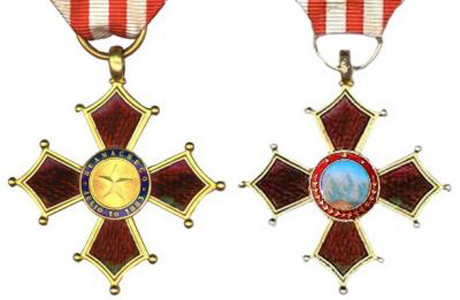
OFFICER'S GOLD CROSS of HUAMACHUCO 1883
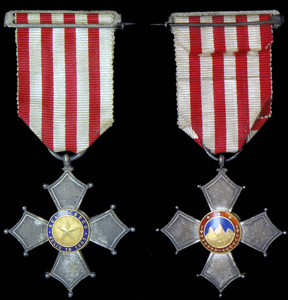
SILVER CROSS of HUAMACHUCO 1883
CROSS for 1879-“1880 This decoration was established by decree of September 1, 1880, for services in the various engagements during the War of the Pacific.
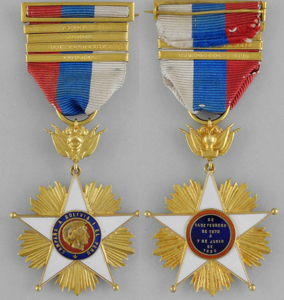
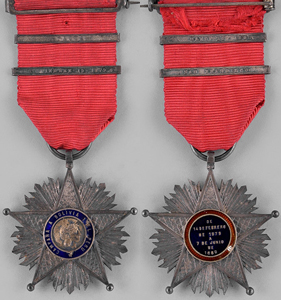
SENIOR OFFICER’S GOLD CROSS with FOUR BARS and SILVER CROSS 1879-1880 for JUNIOR OFFICERS and TROOPS
For senior officers, it is a five-armed, 40 mm gold, white-enameled ball-tipped star with rays in the angles and suspended from a helmet and flags. In the center medallion is the head of Bellona, Goddess of War, on a red enamel field, around which is a blue-enamel band inscribed in letters of gold, CAMPANA A BOLIVIA I EL PERU. The reverse, encircled by a red enamel band is the inscription, DE 14 DE FEBRERO DE 1879 A 7 DE JUNIO DE 1880 on a blue- enamel field. The ribbon of the gold cross is red, blue and white. Bars were attached to the ribbon for the several engagements: (1) ARICA; (2) TACNA; (3) LOS ANGELES; (4) TARAPACA; (5) SAN FRANCISCO; (6) PISAGUA; (7) CHORILLOS; (8) ANGAMOS; (9) MIRQFLORES; (10) CHIPANA; (11) ANTOFAGASTA or (12) SORPRESA DE IQUIQUE. With the following dates placed on the reverse accordingly: (1) NOVIEMBRE 2, 1979; (2) NOVIEMBRE €“19, 1879; (3) MAYO 26, €“1880 or (4) JUNIO 7, “1880.The silver cross for junior officers and troops is similar to the gold cross, but without the helmet and flag suspension and with the arms of the cross decorated with scales in lieu of enamel. The ribbon is solid red. The same ribbon bars are applicable.
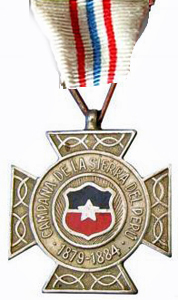
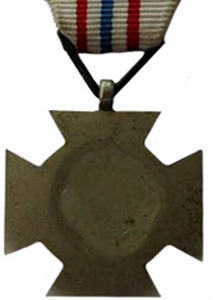
CROSS for the CAMPAIGN of the PERUVIAN HIGHLANDS 1879-84 and
CROSS for the CAMPAIGN of the PERUVIAN HIGHLANDS 1879-1884 AKA the CAMPAIGN MEDAL for the SIERRA of PERU This is an award for those who fought in the War of the Pacific and against the Peruvian Guerilla resistance. The gilt medal is in the shape of a Cross Pattee. The center obverse features an enameled shield from the Chilean coat-of-arms. Below the shield are the dates 1879-1884. The circular inscription reads, CAMPANA DE LA SIERRA DE PERU 1869-1884. The reverse is blank. A variant has blue enamel on the arms and red enamel surrounding the enameled shield. It might possibly be a “do-it-yourself” enhancement.
COMMEMORATIVE for the HEROES of the BATTLE OF CONCEPCION One of the most dramatic events of the Pacific War occurred on July 9-10, 1882 in the Peruvian town of La Concepcion. The entire garrison of the Chacabuco Regiment, composed of 77 officers and men, under command of Capitan Ignacio Carrera Pinto, resisted an attack by 2,000 Peruvian soldiers for two days, resulting in the death of the entire Chilean Regiment. The Chilean stand is considered one of the greatest deeds of the war.
It was subsequently avenged by Chilean reinforcements, who sacked the town and killed all, but two of the remaining citizens. Col. Del Canto ordered that the hearts of the four officers: Captain Ignacio Carrera Pinto, Lieutenant Julio Montt, and Second Lieutenants Arturo Perez Canto and Luis Cruz Martinez, be extracted and sent in formalin to Santiago; the remains of the 77 Chileans were buried beside the church. Only in 1911, in one of Santiago's churches, were the hearts of the 4 officers permanently interred with a marker dedicated to the memory of all 77 killed in these two memorable days in Chilean history.
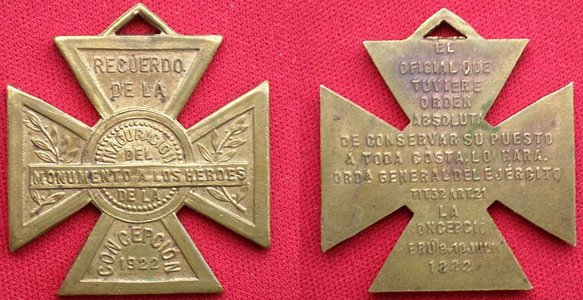
GOLD COMMEMORATIVE for the HEROES of the BATTLE OF CONCEPCION
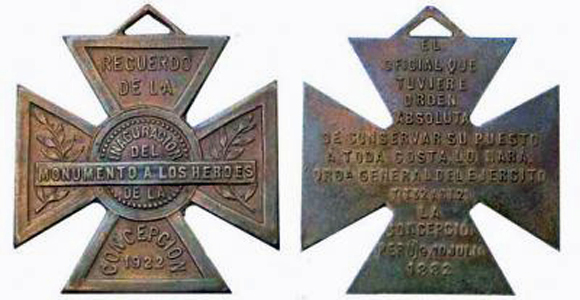
BRONZE COMMEMORATIVE MEDALS for the HEROES of the BATTLE OF CONCEPCION
Every July 9, all across Chile in ceremonies marking the final great Chilean military defeat, the battle is commemorated by the famous Juramento de la Bandera (Pledge to the Flag). It is recited throughout Chile in memory of this great and memorable battle, by the officers, warrant officers, non-commissioned officers, enlisted personnel, officer cadets and NCO cadets as part of a solemn yearly tradition ever since it was first recited on July 9, 1939.
On the occasion of the 1922 dedication of a monument to the Heroes of the Battle of Concepcion, the Chilean government authorized a 40 mm silver and bronze commemorative medal in the form of a Cross Patte with a triangular shaped hanger in honor of the sacrifice made by their Regiment. The obverse is inscribed, RECUERDO DE LA on the upper arm, INAUGURATION DEL in the upper portion of the central rondel, MONUMENTO A LOS HEROES across the center, DE LA in the lower portion of the rondel and CONCEPCION 1922 on the lower arm. The reverse is inscribed with an excerpt from Title 31, Article 21 of the General Orders of the Chilean Army, THE OFFICER WHO HAS ABSOLUTE ORDER TO KEEP HIS POSITION AT ALL COSTS, WILL DO IT. The medal has been observed suspended from the same ribbon as the Cross for the Campaign of the Peruvian Highlands.
Since the medal had an "unofficial"� status, images of it being worn by active military as well as veterans exist. Of small note, the badge is nearly identical to the Peruvian medal for the Battle of San Pablo on July 13, 1882, except for the inscriptions.
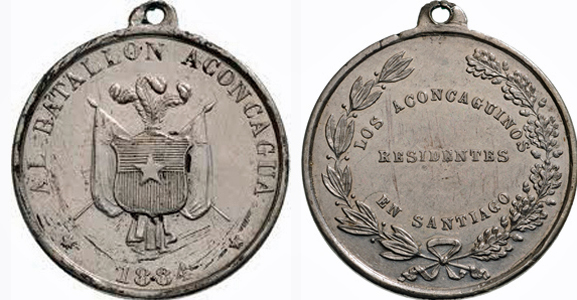
MEDAL for BATALLON of ACONCAGUA 1884
BATTLE of PUNYAN HILL The Chilean army decided to launch an attack against the Confederation at Punyan Hill. The Aconcagua Battalion was dispatched to clear the hill of enemy forces and succeeded. Aconcagua, situated in the Andes, with a summit elevation of 6,960.8 meters (22,837 ft), is the highest peak in both the Southern and Western Hemispheres. MEDAL for BATALLON of ACONCAGUA 1884 This is a 24 mm, silver or bronze medal. The obverse bears a shield with the arms of Chile, surmounted by three plumes and superimposed on two crossed flags. The curved inscription around the border reads, AL BATALLON ACONCAGUA 1884. The reverse, within knotted laurel branches is inscribed, LOS ACONCAGUINOS RESIDENTES EN SANTIAGO. The ribbon is solid red, although the medal has been observed on a red-blue-white ribbon in the Chilean publication, Represntantes Provincia Aconcagua Guerra Pacifico 1879.
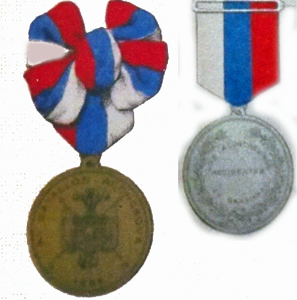
IMAGES from REPRESNTANTES PROVINCIA ACONCAGUA GUERRA PACIFICO 1879
Website Maintained by Vaudezilla