The War of the Confederation was a conflict between the Peru-Bolivian Confederation and a coalition of Argentina and the United Restorative Army, which was composed of Chile and North Peruvian dissidents, from 1836 to 1839. The creation of the Peru-Bolivian Confederation under Andrés de Santa Cruz started a power struggle in southern South America, with Chile and Argentina independently invading the Confederation to protect their interests out of fear of the potential political, military, and economic power of the new Confederation. Argentina was defeated in 1837, but the conflict continued for two years until United Restorative Army victory at the Battle of Yungay. The victory resulted in the dissolution of the Peru-Bolivian Confederation, the exile of Bolivian President Andres de Santa Cruz, and the restoration of Peru and Bolivia as separate countries.
MEDAL of MONTEAGUDO 1836 On July 7, 1836, the Peru-Bolivian Confederation frigate, Monteagudo, leased to Ramon Freire, sailed bound to Chiloe in ostensive support of Ramon Freire. The exiled former head of Chile had departed for Chiloe four days earlier on the brigantine Orbegoso. During the voyage, the Monteagudo crew revolted against Freire's partisans on board and proceeded to Valparaíso to deliver both the ship and the prisoners to the Chilean authorities. The existence of this medal is known by a decree of September 5, 1836, by which gold medals were awarded to Manuel Zapata and Jose Rojas for their actions. In addition, Manuel Zapata and Jose Rojas were awarded the sum of 500 pesos each and pensions of 200 pesos per year for life. An additional 6,000 pesos were awarded to be shared by the other crew members, based on their actions until the Monteagudo arrived in Valparaiso.
The obverse of the medal, believed to be round, is inscribed, FIEL A LA PATRIA EN 1 DE AGOSTO DE 1836 within a laurel wreath. The reverse is inscribed, A LA LEALTAD MANIFESTADA EN LA FRAGATA MONTEAGUDO. The Monteagudo, later participated in the otherwise indecisive Battle of Islay as part of the Chilean forces during January 12-13, 1838. The ship sank in a gale off Valparaiso on July 24, 1839.
Since only two medals were created and awarded, it is extremely rare and an example could not be located in any of the Chilean museums.
BATTLE of CERRO BARON The battle of Cerro Baron took place in the hills and neighborhood of the City of Valparaiso on June 6, 1837. The combat pitted the mutineers, Cazadores de Maipu Regiment, commanded by Colonel Jose Antonio Vidaurre, against the troops loyal to the government led by Manuel Blanco Encalada. The mutineers had just assassinated Minister Diego Portales. Encalada’s forces routed the mutineers. Vidaurre fled through the vineyard of Vina del Mar where he was captured and executed.
STAR for BARON 1837 The decree of June 16, 1837 instituted these five-pointed, 38 mm stars (with finial ball tips) in gold for officers and silver for troops of the United Restorative Army. The circular medallion on the obverse bears a bicolor shield on which another five-pointed star (the Arms of Chile) is displayed. This is encircled by the inscription, A LOS FIELES DEFENSORES D LA LEI. The reverse medallion bears a larger five-pointed star in its center, encircled by a band with the inscription, ALTURAS DEL BARON JUN. 6 DE 1837. There are slight differences between the gold and silver stars. The circle on the gold is enameled blue on obverse and red on the reverse. The central shield on the obverse is also enameled blue in the upper half and red in the lower half. The ribbon is dark blue with red side stripes.
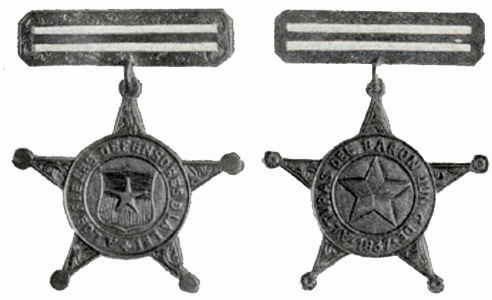
SILVER STAR for BARON 1837 (Obverse & Reverse)
STAR for ANCACHS 1839 Ancachs is a maritime province of Peru, north of Lima. One of the engagements during the three year war against the Confederation of Peru and Bolivia, took place there and Chile awarded this decoration to members of the army, by a decree of March 28, 1839.
It is a 44 x 48 mm eight-pointed star issued in gold or silver. This star is composed of rays with a green laurel wreath in high relief surrounding the center and within it a white-enamel band, inscribed, AL VALOR INVENCIBLE EN ANCACHS. Within the inscribed white-enamel band, is a central red-enamel medallion with a white-enamel star. The reverse is inscribed 20 ENERO DE 1839. There is also a 36 mm gold variant of seven-points with only ANCACH on the obverse band and without the green-enamel wreath.
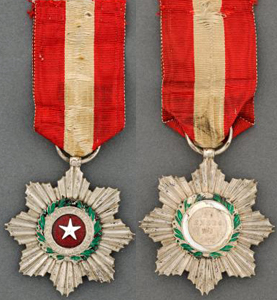
STAR for ANCACHS in SILVER 1839
CROSS for YUNGAY 1839 During the war against the Peruvian-Bolivian Confederation, a battle was fought at the gold-mining village of Yungay in the province of Ancachs, Peru. The Chilean troops defeated the Peruvians led by Andres de Santa Cruz, which marked the end of the Confederation of Peru and Bolivia.
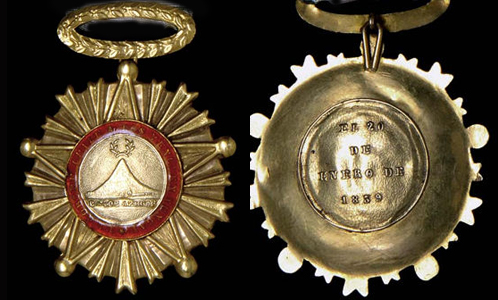
GOLD CROSS for YUNGAY 1839
The Cross was established by decree of March 25, 1839. It was awarded to officers of the Chilean army, who fought in the battle. It is a five-pointed star with finial ball tips and rays in the angles. The five arms should be enameled white. The gold cross has a wreath (usually green enamel) for the ribbon suspension. The gilt central medallion depicts a village in the foreground at the base of the Antuco volcano in the background. The circular red-enamel band is inscribed, EL GOB DE CHILE A LOS VENCI EN YUNGAY. The reverse is inscribed on four straight lines, EL 20 DE ENERO DE 1839. The central medallion is made as a separate part, struck from dies at the Santiago mint. It was then added to the cross and the rays as a separate unit. The correct ribbon is light blue.
MEDAL for YUNGAY 1839 This is a 36 x 30 mm, oval shaped, silver medal authorized on December 21, 1839. The obverse is inscribed, YO FUI DEL EJERCITO RESTAURAD'R on a shield bordered by two laurel branches surmounted by a radiant five-pointed star. The reverse is inscribed within laurel branches, VENCEDOR EN YUNGAY EL 20 DE ENERO DE 1839. The correct ribbon for both the star and the medal is light blue.
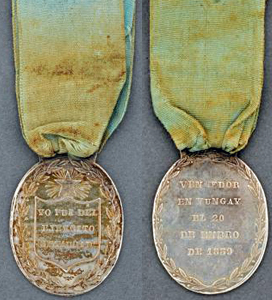
MEDAL for YUNGAY 1839 with RIBBON
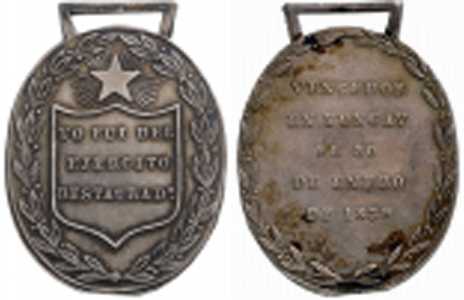
BRONZE MEDAL for YUNGAY 1839 DETAIL
The BATTLE of CASMA occurred on January 12, 1839, during the War of the Confederation, a conflict between Chile and the Peru–Bolivian Confederation. The government of the Confederation hired privateers to counter the Chilean navy, offering a bounty of 200,000 pesos for the destruction of the Chilean fleet. When the Chileans lifted the blockade of Callao, four privateer ships sallied to earn that bounty. The ships were Mexicana, Peru, Arequipeno and Edmond under the overall command of Juan Blanchet, a former Lieutenant of the French navy.
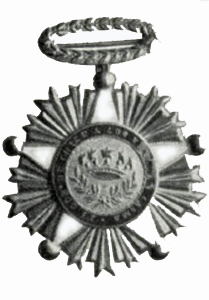
CROSS for CASMA 1839
The Chilean squadron, commanded by Robert Simpson, consisted of the ships Confederacion, Santa Cruz and Valparaíso. The Chilean squadron was taking on firewood in Casma Bay when it was attacked by the privateers. The more heavily built Chilean ships inflicted heavy casualties on the privateers and captured the Arequipeno. Blanchet was among the killed. The other privateer ships escaped while flying French flags but were intercepted by a French warship; the privateer squadron was subsequently disbanded. Both sides claimed victory. The Chileans gained naval supremacy in the southeastern Pacific. As a reward, Simpson was promoted to the rank of Commodore in the Chilean Navy during May 1839.
CROSS for CASMA 1839 By decree of March 28, 1839, this 40 mm, five-armed cross with finial balls and rays between the points was awarded for the naval combat at Casma. It is similar to the Cross for Yungay except for the white-enameled center, which bears a naval crown above two laurel branches, around which is a red-enameled band inscribed, EL GOB DE CHILE A LOS VENC EN CASMA. The reverse medallion is inscribed, EL 13 DE ENERO DE 1839. The ribbon is light blue.
Website Maintained by Vaudezilla