The CHINCHA ISLANDS WAR, also known as Spanish–South American War was a series of coastal and naval battles between Spain and its former colonies of Peru and Chile from 1864 to 1866. The conflict began with Spain's seizure of the guano-rich Chincha Islands in one of a series of attempts by Spain, under Isabella II, to reassert its influence over its former South American colonies. The war saw the deployment of ironclads, including the Spanish ship, Numancia, the first ironclad to circumnavigate the world.
On April 14, 1864, in retaliation for Peru's refusal to pay an indemnity, the Spanish fleet seized the lightly defended Chincha Islands. The islands were the principal source for Peruvian guano, an important agricultural resource. The Spanish placed the Peruvian governor of the Islands, Ramon Valle Riestraunder, under arrest aboard the Resolucion, occupied the islands with 400 marines and raised the Spanish flag. Spain considered these islands an important bargaining tool, as they were a major Peruvian economic asset and produced almost 60% of the government's annual revenue. The Spanish squadron also blockaded principal Peruvian ports, disrupting commerce and fostering a high level of resentment throughout Latin America. Spain expected little resistance from Peru, believing its military capabilities to be negligible.
Even before Chile and Peru were formally allied, Spain had suffered a humiliating naval defeat at the Battle of Papudo on November 26, 1865. During this engagement, the Chilean corvette Esmeralda captured the Spanish schooner Covadonga, taking the crew prisoner and seizing the Admiral's war correspondence. This humiliation was too much for Admiral Pareja, and he committed suicide two days later aboard his flagship. Following the Admiral's death, the general command of the Spanish fleet in the Pacific was assumed by Commodore Casto Mendez Nunez, who quickly received a promotion to rear admiral.
Chile and Peru formally signed an alliance against Spain on December 5, 1865. The Peruvian Congress ratified this alliance on January 12, and two days later (January 14, 1866), Peru finally declared war on Spain. Chile's navy was weak, almost non-existent. To reinforce its Chilean ally, a Peruvian squadron under the command of Captain Lizardo Montero was immediately dispatched to the south. Among the ships in the squadron were the steam frigates Amazonas and Apurímac.
Spain's Admiral Mendez Nunez sent two of his most powerful ships (the frigates Villa de Madrid and Reina Blanca) south to destroy the combined Chilean-Peruvian fleet. The allied squadron had been placed under the command of Peruvian Captain Manuel Villar and had taken refuge at Abtao, a well-protected inlet near the gulf of Chiloe in southern Chile. The Spanish squadron appeared at the entrance of the inlet on February 7, 1866, but the Spanish did not enter as they did not want to risk their ironclads running aground in the shallows. A cannonade lasting several hours was exchanged with little effect. In spite of being at anchor, without steam, and with some ships with their engines undergoing overhaul, the Peruvian-Chile allies mounted an energetic fight. The Covadonga, under the command of Lieutenant Manuel Thomson, managed to fire over an island and scored several hits on the frigate Blanca. The battle ended indecisively without further developments. Reluctant to enter shallow waters and realizing that a long- range gun duel served no purpose but to waste ammunition, the Spanish commanders withdrew.
Williams and the Esmeralda were not at the anchorage on the day of the battle. The commodore had sailed to Ancud for coaling. On its way back to Valparaiso, the Spanish squadron captured a Chilean steamboat (the Paquete del Maule) that was transporting sailors to crew the new Peruvian ironclads Huoscar and Independencia.
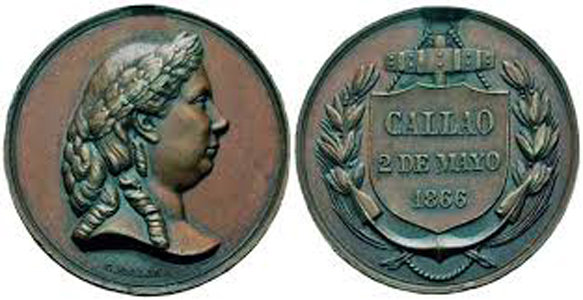
SPANISH MEDAL for CALLAO 1866
Admiral Mendez Nunez, displeased at having to resort to destroying defenseless targets such as Valparaiso and with the inconclusive result at Abtao, decided to change tactics and attack a heavily defended port. As a result, the Admiral set sail for the Peruvian port city of Callao. The Battle of Callao took place on May 2. After the battle, both sides claimed victory. Peruvian defenders claimed that they had halted the Spanish from regaining their lost authority and prestige in South America, prevented them from enforcing their demands upon Peru and forced the withdrawal of the Spanish fleet (technically correct, since Peruvian cannons fired the last shots in the battle). The Spanish claimed to have visited punishment upon its former colony. Spanish guns had managed to cause only limited damage to defenses, and most of the cannons and artillery as well as buildings within Callao, itself, survived the battle intact.
MEDAL for CALLAO 1866 This 30 mm Spanish medal was engraved and signed (on the obverse) by Gregorio Sellan. It features the bust of Queen Isabella II on the obverse and a shield placed on top of anchor framed in laurel leaves on the reverse. The shield reads CALLAO 2 DE MAYO 1866 on three straight lines. The medal is a testament to the fact that both sides claimed victory at the battle.
A variation of this decoration for gunners is a five-pointed star with finial balls, enameled red, and surmounted by a green-enameled wreath of laurel for the suspension ribbon. On the white enamel center medallion is the fortress at Callao, encircled by a band inscribed in gold, CALLAO 2 DE MAYO DE 1866. The reverse is inscribed, 50 CANONES CONTRA 500.
Whether the suspicions of a Spanish scheme to recapture its former colonies had any basis in fact is unknown. Many in South America saw Spain's meddling in Latin America and its occupation of the Chincha Islands as proof of a long-range Spanish plot to reassert its influence over its previous colonial territories. The force sent by Spain, on the other hand, amounted to a mere squadron of ships with negligible capabilities for landing forces, and the intention may have only been to seize the islands for their valuable fertilizer resources as reparations and to regain some of Spain's lost prestige. Regardless of the reason behind the conflict, Spain found it impossible to hold their positions. With all ports south of Colombia closed to them for coaling and provisioning, the Spanish fleet withdrew from patrolling the South American coastline, vacated the Chincha Islands and returned to Spain.
MEDAL for PAPUDO 1865. In 1865, Chile became involved in a war with Spain, owing to her sympathy for Peru, and many Chilean ports were blockaded. This 38 mm decoration in gold or silver, was awarded by Bolivia to the Chilean Navy crew of the Esmeralda. It is a six-armed Maltese cross, ball-tipped, superimposed on a laurel wreath. In the round center medallion is the bust of the Bolivian President Melgarejo, encircled by BOLIVIA A LOS VALI DE LA ESMERALDA. On the reverse are the arms of Bolivia, encircled by, PAPUDO NOVIEMBRE 26 DE 1865. On the suspension wreath above the medal is a band inscribed, VIVE CHILE.
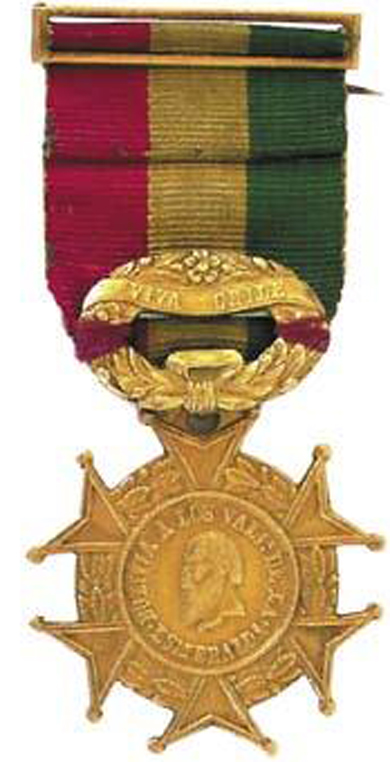
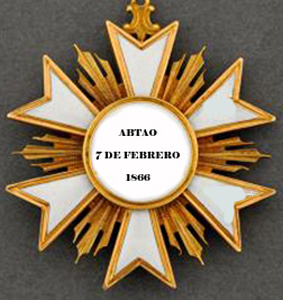
GOLD MEDAL for PAPUDO 1865 and CROSS for ABTAO 1866
CROSS for ABTAO 1866 Abtao Cove is near Antofagasta, a part of Bolivia in 1866. The decoration for this engagement with the Spanish naval forces, is a gold or silver cross of six double-pointed arms, enameled white and with three gold rays in each of the angles. The white central medallion on the obverse is inscribed, ABTAO 7 DE FEBRERO 1866, and the reverse is inscribed, LA PATRIA RECONCIDA.
MEDAL for ABTAO This is a 32 x 26 mm oval, gold, silver or bronze medal. The obverse displays a shield superimposed on the flags of Bolivia, Chile and Peru, and trophies of war. The shield is inscribed, A LOS VENCEDORES EN ABTAO. The reverse is inscribed, 7 DE FEBRERO 1866, 57 CANONES CONTRA 92. It was awarded for the relief of Abtao and for the defeat of two Spanish ships, the Blanca and Villa de Madrid.
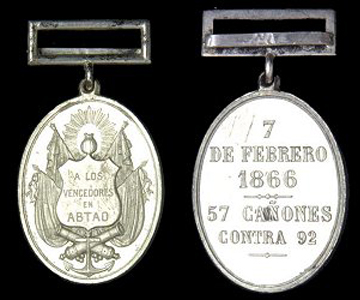
SILVER MEDAL for ABTAO 1866
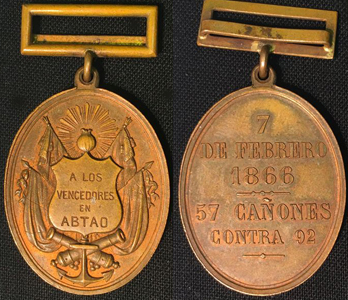
BRONZE MEDAL for ABTAO 1866
PERUVIAN MEDAL for DEFENSE of CALLAO This Peruvian medal was also awarded to Chilean forces, who assisted in the defense of Callao. It is a five-armed red enamel star with finial ball tips and a green enamel wreath suspension for the gold class and a ring suspension for the silver class. The white enamel center features the fort’s tower surrounded by the inscription, CALLAO 2 DE MAYO 1866. The reverse is otherwise blank except for a white enamel central ring, inscribed, 50 CANONES CONTRA 300. It was awarded to Chilean forces with their red, blue and white ribbon, the national colors of Chile.
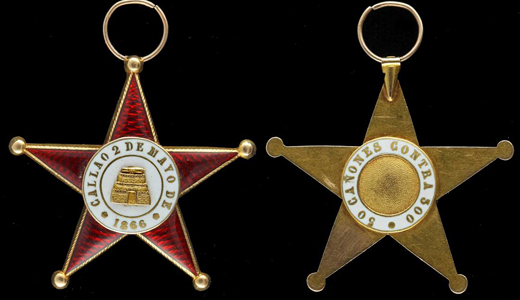
PERUVIAN MEDAL for DEFENSE of CALLAO
Website Maintained by Vaudezilla