The Xhosa Campaigns (1834-1853)
The Xhosa Wars (also known as the Cape Frontier Wars, Kaffir Wars, or Africa's 100 Years War), were a series of nine wars or flare-ups (from 1779 to 1879) between the Xhosa tribes and European settlers in what is now the Eastern Cape in South Africa. These events were the longest-running military action in the history of African colonialism. Three of these Xhosa Wars were initially recognized by the South Africa Medal.
Sixth Xhosa War (1834-36)
The earlier Xhosa Wars did not quell British-Xhosa tension in the Cape's eastern border at the Keiskamma River. Insecurity persisted because the Xhosa remained expelled from territory (especially the so-called "Ceded Territories") that was then settled by Europeans and other African peoples. They were also subjected to territorial expansions from other Africans that were themselves under pressure from the expanding Zulu Kingdom. Nevertheless, the frontier region was seeing increasing amounts of admixture between Europeans, Khoikhoi and Xhosa living and trading throughout the frontier region. The vacillation by the Cape Government's policy towards the return of the Xhosa to areas they previously inhabited did not dissipate Xhosa frustration toward the inability to provide for themselves and they resorted to frontier cattle-raiding.
Seventh Xhosa War (1846-47)
The Seventh Xhosa War is often referred to as the "War of the Axe" or the "Amatola War." On the colonial side, two main groups were involved: columns of imperial British troops sent from London, and local mixed-race Burgher forces, which were mainly Khoi, Fengu, British settlers and Boer commandos, led by their commander-in-chief, Andries Stockenstrom. Relations between the British Imperial troops and the local commandos broke down completely during the war. On the Xhosa side, the Ngqika (known to the Europeans as the Gaika) were the chief tribe engaged in the war, assisted by portions of the Ndlambe, and the Thembu. The Xhosa forces were over ten times greater in number, and had by this time replaced their traditional weapons with modern firearms. It was their new use of guns that made the Xhosa considerably more effective in fighting the British. The war saw widespread use, by both sides, of scorched earth tactics.
At the conclusion, following protracted negotiations, the Xosha agreed to return any raided cattle and other property and to relinquish claims to the Ngqika land west of the Kei. They also promised to use his limited authority over the frontier Ngqika to restrain cross-border attacks. A treaty was signed and the commandos departed on good terms.
Eighth Xhosa War (1850-53)
Large numbers of Xhosa were displaced across the Keiskamma by Governor Harry Smith, and these refugees supplemented the original inhabitants there, causing overpopulation and hardship. Those Xhosa who remained in the colony were moved to towns and encouraged to adopt European lifestyles.
Harry Smith also attacked and annexed the independent Orange Free State, hanging the Boer resistance leaders, and in the process alienating the Burghers of the Cape Colony. To cover the mounting expenses, he then imposed exorbitant taxes on the local people of the frontier and cut the Cape's standing forces to less than five thousand men.
In June 1850, there followed an unusually cold winter, together with an extreme drought. It was at this time that Smith ordered the displacement of large numbers of Xhosa squatters from the Kat River region. The war became known as Mlanjeni's War, after the prophet Mlanjeni who arose among the homeless Xhosa, and who predicted that the Xhosa would be unaffected by the colonists' bullets.
The Ninth War Campaigns of 1877-1879
The military campaigns recognized by the second version of the South Africa Medal were:
Gaika-Gcaleka War
The Gaika-Gcaleka War was a series of punitive campaigns which resulted from the attacks of the Gcaleka and Gaika tribes on a protected people, the Fengu. The campaigns against the insurgent Gcaleka and Gaika lasted some eight months and were carried out by local Colonial Forces as well as contingents of both the British Army and the Royal Navy serving ashore. The Gaika-Gcaleka War, which became known as the Ninth Cape Frontier War, ended with the annexation of the Transkei, homeland of the Gcaleka peoples, by the Cape of Good Hope.
Sekhukhune Wars
Once the Gaika-Gcaleka War was settled, those forces not embroiled in the developing conflict in Zululand were employed against a Basuto tribe in the northern Transvaal, the Bapedi of Chief Sekhukhune, whose raids had begun to affect tribes under British protection. After an initial sally against his fortress at Thaba Ya Leolo in late 1878 had proved ineffective, a larger force overran his fortress in November 1879. The defenders of the fortress were killed almost to a man, largely by African soldiery.
Anglo-Zulu War
Even though an independent commission had adjudged in 1878 that most of the Zulu claims to border territories were justified, the repeated infractions and raids which were either perpetrated or provoked by the Zulu subjects of Cetshwayo led to a decision by the British commissioner in the area, Sir Henry Bartle Frere, to finally reduce the independence of the Zulu Kingdom. He demanded a complete disarmament on the part of the Zulus and the imposition of a British residency. When Cetshwayo ignored this demand, British forces invaded Zululand in January 1879. After an initial British defeat in the Battle of Isandlwana (see below), reinforcements ensured British victory in the Battle of Ulundi, after which most of the Zulu chiefs sought peace. Cetshwayo became a fugitive and was eventually captured and imprisoned in Cape Town.
Key Anglo-Zulu Battles included:
Battle of Isandlwana
The Battle of Isandlwana on January 22, 1879 was the first major encounter in the Anglo–Zulu War between the British Empire and the Zulu Kingdom. Eleven days after the British commenced their invasion of Zululand in South Africa, a Zulu force of some 20,000 warriors attacked a portion of the British main column consisting of about 1,800 British, colonial and native troops and perhaps 400 civilians. The Zulus were equipped mainly with the traditional assegai iron spears and cow-hide shields, but also had a number of muskets and old rifles though they were not formally trained in their use. The British and colonial troops were armed with the modern Martini-Henry breech-loading rifles and two 7-pounder mountain guns deployed as field guns, as well as a Hale rocket battery. Despite a vast disadvantage in weapons technology, the numerically superior Zulus ultimately overwhelmed the poorly led and badly deployed British, killing over 1,300 troops, including all those out on the forward firing line. The Zulu army suffered around a thousand killed. The battle was a decisive victory for the Zulus and caused the defeat of the first British invasion of Zululand.
Battle of Rorke's Drift
The depot at Rorke's Drift was attacked against the orders of Cetshwayo, who favoured a defensive strategy. After the overwhelming victory over the British at Isandlwana, Zulu reserve forces who were not involved in the previous day’s battle retaliated with an attack on the hastily erected fort and the small garrison of Rorke’s Drift. Here the British fought with rifle fire and bayonets and the Zulu force, led by Prince Dabulamanzi, suffered 500 casualties in this fruitless engagement. This provided the British with much needed propaganda to counter the Zulu success at Isandlwana.
Battle of Ulundi
The Battle of Ulundi took place at the Zulu capital of Ulundi on July 4, 1879 and was the last major battle of the Anglo-Zulu War. The British army broke the military power of the Zulu nation by defeating the main Zulu army and immediately afterwards capturing and razing the capital of Zululand, the royal kraal of Ulundi.
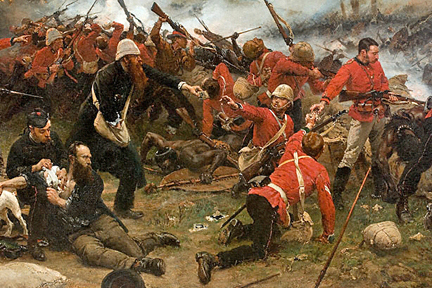
Defense of Rorke's Drift
The South Africa Medal
On November 22, 1854, Queen Victoria gave approval for the award of the South Africa Medal (1853) to members of the British Army who had served in any one of the three South African Xhosa Wars of 1834–36, 1846–47 and 1850–53 (also known as the Kaffir Wars) on the Eastern Frontier of the Cape of Good Hope. A total of 8,540 medals were issued.
Between 1877 and 1879, a number of particularly difficult punitive expeditions were mounted by the British against Xhosa, Zulu, and Basuto tribes in the eastern area of the Cape of Good Hope and northern Natal, as well as against the Bapedi of Chief Sekhukhune in the northern Transvaal. On August 1, 1880, an updated version of the South Africa medal was sanctioned for these campaigns. This new version of the South Africa Medal (1853) contained minor alterations to the reverse design. Approximately, 36,600 were issued.
The 36mm silver medal was struck as a disk with a swiveling suspender.
Both the 1853 and 1879 medal's obverse displays the diademed head of Queen Victoria, facing left. The medal is inscribed - VICTORIA at left and REGINA at right - around the perimeter.
The reverse depicts a lion couchant (prostrated) on a plinth in front of a protea bush with a single flower. The medal is inscribed, SOUTH AFRICA around the top perimeter and has a military trophy consisting of a Zulu ox-hide shield and four crossed assegais (a slender, iron-tipped, hardwood spear) in the exergue (below the principal image of the lion). The reverse of the first version also reflects the date 1853 below the lion.
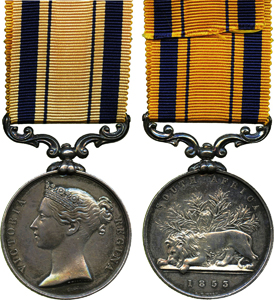
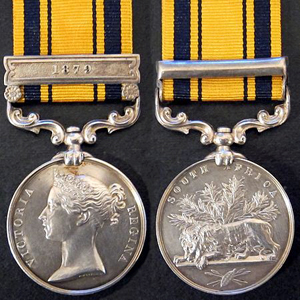
1853 South Africa Medal and the Second Version 1880 with 1879 Clasp
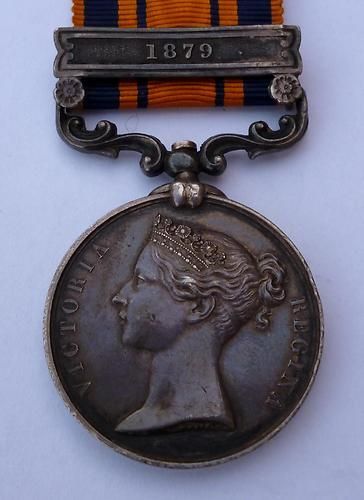
Bronze Second Version 1880 with 1879 Clasp
The medal is sometimes referred to as the Zulu War Medal. A total of approximately 36,600 medals were awarded, 5,600 with no clasp, often viewed as "non-combat" versions. Some commentators fail to mention that the medal was also issued in bronze.
Seven clasps were awarded to recipients who had served in a campaign in the year denoted or in each of the years denoted on the clasp:
The Xhosa Wars (also known as the Cape Frontier Wars, Kaffir Wars, or Africa's 100 Years War), were a series of nine wars or flare-ups (from 1779 to 1879) between the Xhosa tribes and European settlers in what is now the Eastern Cape in South Africa. These events were the longest-running military action in the history of African colonialism. Three of these Xhosa Wars were initially recognized by the South Africa Medal.
Sixth Xhosa War (1834-36)
The earlier Xhosa Wars did not quell British-Xhosa tension in the Cape's eastern border at the Keiskamma River. Insecurity persisted because the Xhosa remained expelled from territory (especially the so-called "Ceded Territories") that was then settled by Europeans and other African peoples. They were also subjected to territorial expansions from other Africans that were themselves under pressure from the expanding Zulu Kingdom. Nevertheless, the frontier region was seeing increasing amounts of admixture between Europeans, Khoikhoi and Xhosa living and trading throughout the frontier region. The vacillation by the Cape Government's policy towards the return of the Xhosa to areas they previously inhabited did not dissipate Xhosa frustration toward the inability to provide for themselves and they resorted to frontier cattle-raiding.
Seventh Xhosa War (1846-47)
The Seventh Xhosa War is often referred to as the "War of the Axe" or the "Amatola War." On the colonial side, two main groups were involved: columns of imperial British troops sent from London, and local mixed-race Burgher forces, which were mainly Khoi, Fengu, British settlers and Boer commandos, led by their commander-in-chief, Andries Stockenstrom. Relations between the British Imperial troops and the local commandos broke down completely during the war. On the Xhosa side, the Ngqika (known to the Europeans as the Gaika) were the chief tribe engaged in the war, assisted by portions of the Ndlambe, and the Thembu. The Xhosa forces were over ten times greater in number, and had by this time replaced their traditional weapons with modern firearms. It was their new use of guns that made the Xhosa considerably more effective in fighting the British. The war saw widespread use, by both sides, of scorched earth tactics.
At the conclusion, following protracted negotiations, the Xosha agreed to return any raided cattle and other property and to relinquish claims to the Ngqika land west of the Kei. They also promised to use his limited authority over the frontier Ngqika to restrain cross-border attacks. A treaty was signed and the commandos departed on good terms.
Eighth Xhosa War (1850-53)
Large numbers of Xhosa were displaced across the Keiskamma by Governor Harry Smith, and these refugees supplemented the original inhabitants there, causing overpopulation and hardship. Those Xhosa who remained in the colony were moved to towns and encouraged to adopt European lifestyles.
Harry Smith also attacked and annexed the independent Orange Free State, hanging the Boer resistance leaders, and in the process alienating the Burghers of the Cape Colony. To cover the mounting expenses, he then imposed exorbitant taxes on the local people of the frontier and cut the Cape's standing forces to less than five thousand men.
In June 1850, there followed an unusually cold winter, together with an extreme drought. It was at this time that Smith ordered the displacement of large numbers of Xhosa squatters from the Kat River region. The war became known as Mlanjeni's War, after the prophet Mlanjeni who arose among the homeless Xhosa, and who predicted that the Xhosa would be unaffected by the colonists' bullets.
The Ninth War Campaigns of 1877-1879
The military campaigns recognized by the second version of the South Africa Medal were:
- The Gaika-Gcaleka War from September 26, 1877 to June 28, 1878
- The action against Chief Pokwane from January 21 to 28, 1878
- The Griqua War from April 14 to November 13, 1878
- The action against Chief Sekhukhune in late 1878
- The Anglo-Zulu War from January 11 to 1 September 1, 1879
- The action against the uprising in Basutoland under Chief Moirosi from 25 March 25 to November 20 1879
- The second action against Chief Sekhukhune from November 11 to December 2, 1879
Gaika-Gcaleka War
The Gaika-Gcaleka War was a series of punitive campaigns which resulted from the attacks of the Gcaleka and Gaika tribes on a protected people, the Fengu. The campaigns against the insurgent Gcaleka and Gaika lasted some eight months and were carried out by local Colonial Forces as well as contingents of both the British Army and the Royal Navy serving ashore. The Gaika-Gcaleka War, which became known as the Ninth Cape Frontier War, ended with the annexation of the Transkei, homeland of the Gcaleka peoples, by the Cape of Good Hope.
Sekhukhune Wars
Once the Gaika-Gcaleka War was settled, those forces not embroiled in the developing conflict in Zululand were employed against a Basuto tribe in the northern Transvaal, the Bapedi of Chief Sekhukhune, whose raids had begun to affect tribes under British protection. After an initial sally against his fortress at Thaba Ya Leolo in late 1878 had proved ineffective, a larger force overran his fortress in November 1879. The defenders of the fortress were killed almost to a man, largely by African soldiery.
Anglo-Zulu War
Even though an independent commission had adjudged in 1878 that most of the Zulu claims to border territories were justified, the repeated infractions and raids which were either perpetrated or provoked by the Zulu subjects of Cetshwayo led to a decision by the British commissioner in the area, Sir Henry Bartle Frere, to finally reduce the independence of the Zulu Kingdom. He demanded a complete disarmament on the part of the Zulus and the imposition of a British residency. When Cetshwayo ignored this demand, British forces invaded Zululand in January 1879. After an initial British defeat in the Battle of Isandlwana (see below), reinforcements ensured British victory in the Battle of Ulundi, after which most of the Zulu chiefs sought peace. Cetshwayo became a fugitive and was eventually captured and imprisoned in Cape Town.
Key Anglo-Zulu Battles included:
Battle of Isandlwana
The Battle of Isandlwana on January 22, 1879 was the first major encounter in the Anglo–Zulu War between the British Empire and the Zulu Kingdom. Eleven days after the British commenced their invasion of Zululand in South Africa, a Zulu force of some 20,000 warriors attacked a portion of the British main column consisting of about 1,800 British, colonial and native troops and perhaps 400 civilians. The Zulus were equipped mainly with the traditional assegai iron spears and cow-hide shields, but also had a number of muskets and old rifles though they were not formally trained in their use. The British and colonial troops were armed with the modern Martini-Henry breech-loading rifles and two 7-pounder mountain guns deployed as field guns, as well as a Hale rocket battery. Despite a vast disadvantage in weapons technology, the numerically superior Zulus ultimately overwhelmed the poorly led and badly deployed British, killing over 1,300 troops, including all those out on the forward firing line. The Zulu army suffered around a thousand killed. The battle was a decisive victory for the Zulus and caused the defeat of the first British invasion of Zululand.
Battle of Rorke's Drift
The depot at Rorke's Drift was attacked against the orders of Cetshwayo, who favoured a defensive strategy. After the overwhelming victory over the British at Isandlwana, Zulu reserve forces who were not involved in the previous day’s battle retaliated with an attack on the hastily erected fort and the small garrison of Rorke’s Drift. Here the British fought with rifle fire and bayonets and the Zulu force, led by Prince Dabulamanzi, suffered 500 casualties in this fruitless engagement. This provided the British with much needed propaganda to counter the Zulu success at Isandlwana.
Battle of Ulundi
The Battle of Ulundi took place at the Zulu capital of Ulundi on July 4, 1879 and was the last major battle of the Anglo-Zulu War. The British army broke the military power of the Zulu nation by defeating the main Zulu army and immediately afterwards capturing and razing the capital of Zululand, the royal kraal of Ulundi.
Defense of Rorke's Drift
On November 22, 1854, Queen Victoria gave approval for the award of the South Africa Medal (1853) to members of the British Army who had served in any one of the three South African Xhosa Wars of 1834–36, 1846–47 and 1850–53 (also known as the Kaffir Wars) on the Eastern Frontier of the Cape of Good Hope. A total of 8,540 medals were issued.
Between 1877 and 1879, a number of particularly difficult punitive expeditions were mounted by the British against Xhosa, Zulu, and Basuto tribes in the eastern area of the Cape of Good Hope and northern Natal, as well as against the Bapedi of Chief Sekhukhune in the northern Transvaal. On August 1, 1880, an updated version of the South Africa medal was sanctioned for these campaigns. This new version of the South Africa Medal (1853) contained minor alterations to the reverse design. Approximately, 36,600 were issued.
The 36mm silver medal was struck as a disk with a swiveling suspender.
Both the 1853 and 1879 medal's obverse displays the diademed head of Queen Victoria, facing left. The medal is inscribed - VICTORIA at left and REGINA at right - around the perimeter.
The reverse depicts a lion couchant (prostrated) on a plinth in front of a protea bush with a single flower. The medal is inscribed, SOUTH AFRICA around the top perimeter and has a military trophy consisting of a Zulu ox-hide shield and four crossed assegais (a slender, iron-tipped, hardwood spear) in the exergue (below the principal image of the lion). The reverse of the first version also reflects the date 1853 below the lion.
1853 South Africa Medal and the Second Version 1880 with 1879 Clasp
Bronze Second Version 1880 with 1879 Clasp
The medal is sometimes referred to as the Zulu War Medal. A total of approximately 36,600 medals were awarded, 5,600 with no clasp, often viewed as "non-combat" versions. Some commentators fail to mention that the medal was also issued in bronze.
Seven clasps were awarded to recipients who had served in a campaign in the year denoted or in each of the years denoted on the clasp:
- 1877 – 153 clasps awarded
- 1877-8 – 5,822 clasps awarded
- 1877-8-9 – 3,525 clasps awarded to recipients who had qualifying service in all three years
- 1877-9 – Eight clasps awarded to recipients who had qualifying service in 1877 and 1879, with no service in 1878
- 1878 – 2,009 clasps awarded
- 1878-9 – 1,185 clasps awarded
- 1879 – 18,332 clasps awarded
Website Maintained by Vaudezilla