The Albert Medal 1866-1971
The Albert Medal was first instituted by a Royal Warrant on March 7,1866 and discontinued in 1971 with the last two awards to the late First Officer Geoffrey Clifford Bye of Boolaroo, New South Wales, Australia, and to the late Kenneth Owen McIntyre of Fairy Meadow, New South Wales, Australia. The medal was named in memory of Prince Albert and was originally awarded to recognize saving life at sea. The original medal had a blue ribbon with two white stripes. The first recipient of the medal was Samuel Popplestone, a tenant farmer, who on March 23, 1866 helped to rescue four men after the cargo ship Spirit of the Ocean lost its battle with force eleven gales and was torn apart as it was swept onto the notorious Start Point rocks in Devon.
Another Royal Warrant in 1867 created two classes of Albert Medal, the first in gold and bronze and the second in bronze, both enameled in blue. The ribbon of the 1st Class was changed to blue with four white stripes.
In 1877, the medal was extended to cover saving life on land and from this point there were two medals with different inscriptions to indicate the basis of the award. The land version was enameled in red, with a red ribbon. The sea version was enameled in blue with a blue ribbon. The event that led to the introduction of the Albert Medal for Gallantry on Land was the Tynewydd Colliery disaster which occurred on April 11, 1877. Subsequently, it was announced that the Albert Medal, Previously bestowed for gallantry in saving life at sea, would be extended for similar actions on land.
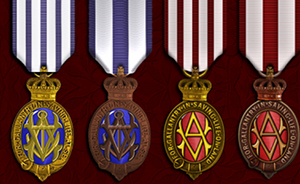
Albert Medal Sea (1st & 2nd Class) and Albert Medal Land (1st & 2nd Class)
In 1917, the titles of the medals changed, the gold (Albert Medal, first class) became the Albert Medal in Gold and the bronze second class became known as just the Albert Medal.
The Albert Medal was an oval medal, 57mm by 30mm surmounted by a representation of the Prince Consort's crown. Early issues were gold and bronze enameled blue (sea) and enameled red (land). The later issues were either gold (1st Class) or bronze (2nd Class) with the same enameling. The medal's obverse consist of a letter "V" (for Victoria) entwined with a letter "A" for Albert. Medals issued for gallantry at sea also have an upright anchor intertwined with the "V" and the "A." The obverse design is encased in a garter with raised inscription reading, FOR GALLANTRY IN SAVING LIFE with AT SEA or ON LAND as appropriate.
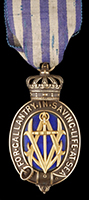
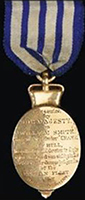
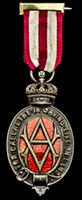
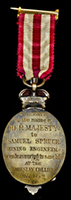
Obverse & Reverse Sea (1st Cl) & Land (2nd Cl) as Inscribed
The reverse was blank and was used to inscribe the details of the award. The Albert Medal in gold was abolished in 1949, and replaced by the George Cross. Subsequently only the bronze Albert Medal was awarded posthumously. In 1971, the Albert Medal was discontinued and all living recipients were invited to exchange the award for the George Cross. From the total of 64 eligible to exchange, 49 elected the option to exchange medals. Total awards of the Albert Medal during its long history were: (1) Sea: 25 gold, plus one for the Board of Trade and 216 bronze and (2) Land: 45 gold and 282 bronze.
The Albert Medal was first instituted by a Royal Warrant on March 7,1866 and discontinued in 1971 with the last two awards to the late First Officer Geoffrey Clifford Bye of Boolaroo, New South Wales, Australia, and to the late Kenneth Owen McIntyre of Fairy Meadow, New South Wales, Australia. The medal was named in memory of Prince Albert and was originally awarded to recognize saving life at sea. The original medal had a blue ribbon with two white stripes. The first recipient of the medal was Samuel Popplestone, a tenant farmer, who on March 23, 1866 helped to rescue four men after the cargo ship Spirit of the Ocean lost its battle with force eleven gales and was torn apart as it was swept onto the notorious Start Point rocks in Devon.
Another Royal Warrant in 1867 created two classes of Albert Medal, the first in gold and bronze and the second in bronze, both enameled in blue. The ribbon of the 1st Class was changed to blue with four white stripes.
In 1877, the medal was extended to cover saving life on land and from this point there were two medals with different inscriptions to indicate the basis of the award. The land version was enameled in red, with a red ribbon. The sea version was enameled in blue with a blue ribbon. The event that led to the introduction of the Albert Medal for Gallantry on Land was the Tynewydd Colliery disaster which occurred on April 11, 1877. Subsequently, it was announced that the Albert Medal, Previously bestowed for gallantry in saving life at sea, would be extended for similar actions on land.
Albert Medal Sea (1st & 2nd Class) and Albert Medal Land (1st & 2nd Class)
In 1917, the titles of the medals changed, the gold (Albert Medal, first class) became the Albert Medal in Gold and the bronze second class became known as just the Albert Medal.
The Albert Medal was an oval medal, 57mm by 30mm surmounted by a representation of the Prince Consort's crown. Early issues were gold and bronze enameled blue (sea) and enameled red (land). The later issues were either gold (1st Class) or bronze (2nd Class) with the same enameling. The medal's obverse consist of a letter "V" (for Victoria) entwined with a letter "A" for Albert. Medals issued for gallantry at sea also have an upright anchor intertwined with the "V" and the "A." The obverse design is encased in a garter with raised inscription reading, FOR GALLANTRY IN SAVING LIFE with AT SEA or ON LAND as appropriate.
Obverse & Reverse Sea (1st Cl) & Land (2nd Cl) as Inscribed
The reverse was blank and was used to inscribe the details of the award. The Albert Medal in gold was abolished in 1949, and replaced by the George Cross. Subsequently only the bronze Albert Medal was awarded posthumously. In 1971, the Albert Medal was discontinued and all living recipients were invited to exchange the award for the George Cross. From the total of 64 eligible to exchange, 49 elected the option to exchange medals. Total awards of the Albert Medal during its long history were: (1) Sea: 25 gold, plus one for the Board of Trade and 216 bronze and (2) Land: 45 gold and 282 bronze.
Website Maintained by Vaudezilla