Canadian Field Hospital
The third Canadian contingent was the only one to transport an entire field hospital with it to South Africa. The 10th Canadian Field Hospital (10 CFH), which departed Canada during January 1902, was a relatively small contingent, consisting of 61 members and 29 horses. It was organized into a hospital staff of five officers, a ward section of 35 other ranks, and 21 other ranks to transport the wounded.
The hospital was based on British practice with Canadian innovations, including improved tenting, ambulances, water trailers, and an acetylene gas lighting system. Many among the members of 10 CFH were veterans of previous tours in South Africa. In South Africa, a section of the unit accompanied the 2nd Regiment, Canadian Mounted Rifles into the western Transvaal. The remainder moved to Vaalbank, 60 kilometers away on the Lichtenberg Blockhouse line. Here they received sick and wounded from the columns operating in the area. This section of 10 CFH remained at Vaalbank until June 18, 1902 during which time it treated over a thousand patients, British, Boer and Black South Africans. The 10 CFH ambulances evacuated patients for longer-term care to Klerksdorp. By all accounts, the 10th Canadian Field Hospital provided outstanding medical services during its stint in South Africa.
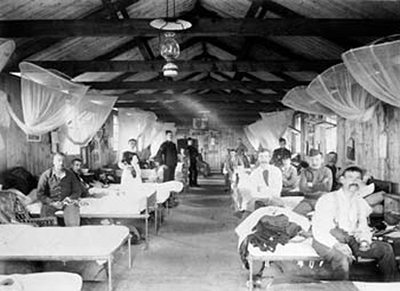
10th Canadian Field Hospital (CFH)
The Canadian Nursing Service sisters included Georgina Pope as head nurse and Forbes, Hurcomb, Macdonald with previous service in South Africa. In addition, Margaret Smith, Eleanor Fortescue, Amy W. Scott, Florance Cameron, sailed an alternate route via London, boarded the S.S. Corinthian at Halifax, departed on the same date as third contingent, arriving in England on February 5th. On the 15th they boarded the RMS Saxon, arriving at Cape Town on March 2nd, staying several days at Wynberg hospital. The sisters, members of the Canadian Medical Corps, presumed they'd be attached to the Canadian 10th Field Hospital, stationed at Newcastle. Although disappointed when the nursing sisters were advised, they wouldn't be joining the 10th, they were ordered and dispatched to No.19 Stationary Hospital, a 600-bed facility on the Platberg, 6,000 feet above sea-level. They boarded the hospital ship Orcana, which transported them to Duram, with a two-day stopover. Then they entrained for Harrissmith, where more than 300 patients were suffering from enteric fever (typhoid). Many of the nursing sisters contracted the illnesses and while some recovered, Sister Hurcomd, plagued by early bouts, contracted a severe case of enteric and was invalided to Canada.
3rd Nursing Contingent: Lead Nurse Georgina Fain Pope, Sarah Forbes, Deborah Hurcomb, Margaret Clotilde Macdonald, with Florence Cameron, Eleanor Fortescue, Amy W. Scott, Margaret Smith
The third Canadian contingent was the only one to transport an entire field hospital with it to South Africa. The 10th Canadian Field Hospital (10 CFH), which departed Canada during January 1902, was a relatively small contingent, consisting of 61 members and 29 horses. It was organized into a hospital staff of five officers, a ward section of 35 other ranks, and 21 other ranks to transport the wounded.
The hospital was based on British practice with Canadian innovations, including improved tenting, ambulances, water trailers, and an acetylene gas lighting system. Many among the members of 10 CFH were veterans of previous tours in South Africa. In South Africa, a section of the unit accompanied the 2nd Regiment, Canadian Mounted Rifles into the western Transvaal. The remainder moved to Vaalbank, 60 kilometers away on the Lichtenberg Blockhouse line. Here they received sick and wounded from the columns operating in the area. This section of 10 CFH remained at Vaalbank until June 18, 1902 during which time it treated over a thousand patients, British, Boer and Black South Africans. The 10 CFH ambulances evacuated patients for longer-term care to Klerksdorp. By all accounts, the 10th Canadian Field Hospital provided outstanding medical services during its stint in South Africa.
10th Canadian Field Hospital (CFH)
3rd Nursing Contingent: Lead Nurse Georgina Fain Pope, Sarah Forbes, Deborah Hurcomb, Margaret Clotilde Macdonald, with Florence Cameron, Eleanor Fortescue, Amy W. Scott, Margaret Smith
Website Maintained by Vaudezilla