The Second Anglo-Chinese War (1856-1860)
Background
The Second Anglo-Chinese or Opium War resulted from the failure of the original 1842 Treaty of Nanking to satisfy British goals of improved trade and diplomatic relations. During October 1856, Chinese Marines boarded and captured the British merchant ship, Arrow. Using this act as justification, the British responded by destroying four Canton border forts and the next day, shelling the city, itself.
France joined the British action against China, prompted by complaints from their envoy, Baron Jean-Baptiste Louis Gros, over the execution of a French missionary, Father Auguste Chapdelaine, by Chinese local authorities in Guangxi province.
The U.S. was involved in a minor concurrent conflict during the war, although they ignored the UK's offer of alliance and did not coordinate with the Anglo-French forces. In 1856, the Chinese garrison at Canton shelled a United States Navy steamer. The U.S. Navy retaliated in the Battle of the Pearl River Forts. The ships bombarded then attacked the river forts near Canton. Diplomatic efforts were renewed afterward, and the American and Chinese governments signed an agreement for U.S. neutrality in the Second Opium War.
In June 1858, the first part of the war ended with the four Treaties of Tientsin, to which Britain, France, Russia, and the U.S. were parties. On 28 May 1858, the separate Treaty of Aigun was signed with Russia to revise the Chinese and Russian border as determined by the Nerchinsk Treaty in 1689. Russia gained the left bank of the Amur River, pushing the border south from the Stanovoy mountains. A later treaty, the Convention of Peking in 1860, gave Russia control over a non-freezing area on the Pacific coast, where Russia founded the city of Vladivostok in 1860.
The Second Battle of Taku Forts took place in June 1859. A British naval force with 2,200 troops and 21 ships, under the command of Admiral Sir James Hope, sailed north from Shanghai to Tianjin with newly appointed Anglo-French envoys for the embassies in Beijing. The next day, the British forces sought to forcibly sail into the Hai River, and shelled the Taku Forts. Low tide and soft mud prevented their landing, however, and accurate fire from Chinese cannons sank four gunboats and severely damaged two others. The British withdrew.
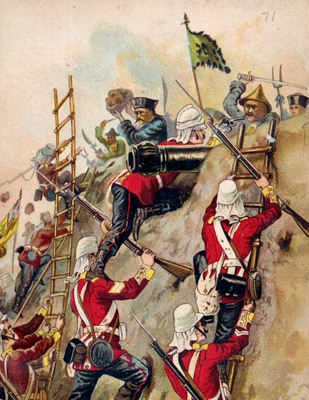
67th Foot Captures a Taku Fort
The Third Battle of Taku Forts took place in the summer of 1860. London once more dispatched Lord Elgin with an Anglo-French force of 11,000 British troops under General James Hope Grant and 6,700 French troops under General Cousin-Montauban. They pushed north with 173 ships from Hong Kong and captured the port cities of Yantai and Dalian to seal the Bohai Gulf. On August 3, they landed near Beitang, approximately 2 miles from the Taku Forts, which they captured after three weeks on August 21.
Following a diplomatic incident involving the British emissaries on September 18, the British sought retribution. This resulted in the annihilation of Qing Army and the destruction of the Summer Palaces. The threat also extended to the Forbidden City, but the threat was never carried out. After the Xianfeng Emperor and his entourage fled Beijing, the June 1858 Treaty of Tianjin was ratified by the emperor's brother, Prince Gong, in the Convention of Beijing on October 18, 1860, bringing The Second Opium War to an end.
Both Britain (Second China War Medal) and France (Commemorative medal of the 1860 China Expedition) issued campaign medals.
Background
The Second Anglo-Chinese or Opium War resulted from the failure of the original 1842 Treaty of Nanking to satisfy British goals of improved trade and diplomatic relations. During October 1856, Chinese Marines boarded and captured the British merchant ship, Arrow. Using this act as justification, the British responded by destroying four Canton border forts and the next day, shelling the city, itself.
France joined the British action against China, prompted by complaints from their envoy, Baron Jean-Baptiste Louis Gros, over the execution of a French missionary, Father Auguste Chapdelaine, by Chinese local authorities in Guangxi province.
The U.S. was involved in a minor concurrent conflict during the war, although they ignored the UK's offer of alliance and did not coordinate with the Anglo-French forces. In 1856, the Chinese garrison at Canton shelled a United States Navy steamer. The U.S. Navy retaliated in the Battle of the Pearl River Forts. The ships bombarded then attacked the river forts near Canton. Diplomatic efforts were renewed afterward, and the American and Chinese governments signed an agreement for U.S. neutrality in the Second Opium War.
In June 1858, the first part of the war ended with the four Treaties of Tientsin, to which Britain, France, Russia, and the U.S. were parties. On 28 May 1858, the separate Treaty of Aigun was signed with Russia to revise the Chinese and Russian border as determined by the Nerchinsk Treaty in 1689. Russia gained the left bank of the Amur River, pushing the border south from the Stanovoy mountains. A later treaty, the Convention of Peking in 1860, gave Russia control over a non-freezing area on the Pacific coast, where Russia founded the city of Vladivostok in 1860.
The Second Battle of Taku Forts took place in June 1859. A British naval force with 2,200 troops and 21 ships, under the command of Admiral Sir James Hope, sailed north from Shanghai to Tianjin with newly appointed Anglo-French envoys for the embassies in Beijing. The next day, the British forces sought to forcibly sail into the Hai River, and shelled the Taku Forts. Low tide and soft mud prevented their landing, however, and accurate fire from Chinese cannons sank four gunboats and severely damaged two others. The British withdrew.
67th Foot Captures a Taku Fort
The Third Battle of Taku Forts took place in the summer of 1860. London once more dispatched Lord Elgin with an Anglo-French force of 11,000 British troops under General James Hope Grant and 6,700 French troops under General Cousin-Montauban. They pushed north with 173 ships from Hong Kong and captured the port cities of Yantai and Dalian to seal the Bohai Gulf. On August 3, they landed near Beitang, approximately 2 miles from the Taku Forts, which they captured after three weeks on August 21.
Following a diplomatic incident involving the British emissaries on September 18, the British sought retribution. This resulted in the annihilation of Qing Army and the destruction of the Summer Palaces. The threat also extended to the Forbidden City, but the threat was never carried out. After the Xianfeng Emperor and his entourage fled Beijing, the June 1858 Treaty of Tianjin was ratified by the emperor's brother, Prince Gong, in the Convention of Beijing on October 18, 1860, bringing The Second Opium War to an end.
Both Britain (Second China War Medal) and France (Commemorative medal of the 1860 China Expedition) issued campaign medals.
Website Maintained by Vaudezilla