The Medals of the First Anglo-Afghan War
Ghuznee Medal
This is a British campaign medal which was awarded for participation in the storming of the fortress of Ghuznee in Afghanistan, from July 21 to 23, 1839 as part of the First Anglo-Afghan War.
This was the second medal awarded to all ranks of the British Army for a specific campaign, the Waterloo Medal being the first. It was struck in 1839 on the orders of Shuja Shah Durrani, the Shah of Afghanistan, to show his appreciation to the British forces, who had restored him to his throne by storming the fortress.
The obverse depicts the fortress of Ghuznee with the word GHUZNEE below, while the reverse has a mural crown surrounded by a laurel wreath and the date 23 JULY 1839. The suspender is straight with a ring passing through a smaller loop affixed to the top of the planchet. Two separate dies exist for this medal with one having a wider border around the edge than the other. The second also has a narrower and taller fortress. The medal was issued unnamed but many were later privately engraved or impressed in varying styles on the reverse or rim.
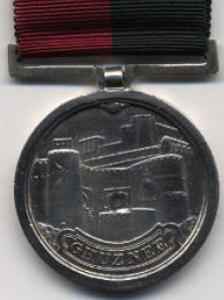
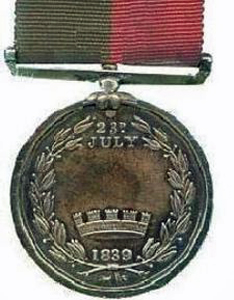
Ghuznee Medal
Ghuznee Medal
This medal was awarded to those who took part in the First Anglo-Afghan War under the command of General William Nott. Approved by General Order at Simla, India in 1842. It was designed by William Wyon.
There are no official clasps (Marzenia 1842 and Tazeane 1842 were sometimes privately added), but the four reverses indicate for which service the medal was issued. These are (1) CANDAHAR 1842 encircled by a laurel wreath surmounted by a royal crown; (2) CABUL 1842 encircled by a laurel wreath with a royal crown above; (3) GHUZNEE CABUL 1842 inside pair of intertwined laurel wreaths (one surrounding Ghunznee and the other Cabul) surmounted by a royal crown and with the date 1842 centered below; and (4) CANDAHAR, GHUZNEE, CABUL 1842 encircled by a laurel wreath with a royal crown above.
In addition two erroneous strikings were made. In one, VICTORIA REGINA rather than VICTORIA VINDEX appears on the obverse. In the other the reverse reads, CABVL 1842.
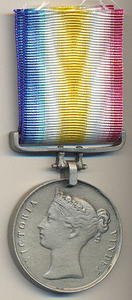
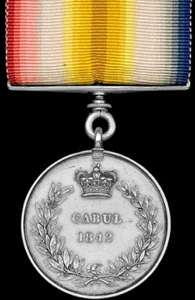
Candahar, Ghuznee, Cabul Medal and Cabul 1842 Reverse
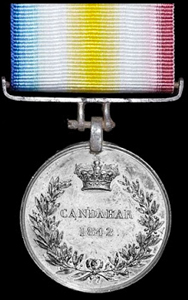
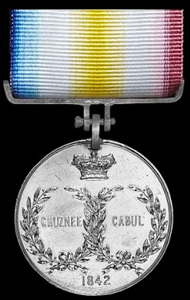
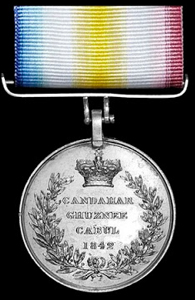
Candahar 1842, Ghuznee Cabul 1842, and Candahar Ghuznee Cabul 1842 Reverses
Jellalalbad Medal
This campaign medal, issued by the British East India Company, was established by the Governor-General of India George Eden on April 30, 1842. The medal was awarded for the defense of Jalalabad, to the troops under the command of Brigadier Sir Robert Sale for the defense of Jalalabad between November 12, 1841 and April 16,1842.
The outpost at Jalalabad was no more than a wide place in the road with a fort, held by about 2,000 troops of the 13th Foot Light Infantry under General Sir Robert Sale. After the massacre of the British force during their retreat from Kabul during January 1842, Jalalabad was surrounded by Afghan forces which launched a series of attacks on the fort. The British managed to beat off the assaults and even captures 300 sheep from the besieging force when rations ran short. Eventually, after five months under siege, Sale mounted a counterattack against the Afghan forces, storming and capturing their main camp, baggage, stores, guns and horses. The Afghans fled back to Kabul. The defense of Jalalabad made heroes of the 13th Foot. It is reported that as the regiment marched back through India to return to Britain, every garrison fired a ten gun salute in its honor. Queen Victoria directed that the regiment be renamed13th (1st Somersetshire) (Prince Albert's Light Infantry) Regiment of Foot. Henceforth, they would wear a badge depicting the walls of the town with the word "Jellalabad."
After the relief of Jalalabad, the Governor-General of India created the silver medal for its defenders, but was dissatisfied with the final design. The design featured a Mural Crown on the obverse with the curved inscription, JELLALABAD in the upper half. The reverse contained the three line inscription, VII/APRIL/1942. When a shortfall in the number produced was discovered the opportunity was taken to completely redesign the medal. Those soldiers awarded the first design were offered a free exchange of it for the second issue but very few chose to do so.
The second issue features the young Queen Victoria on the obverse with the inscriptions, VICTORIA on the left and VINDEX on the right. The reverse featured the winged figure of Victory with laurel wreath in her right hand and union jack in her left with the curved inscription, JELLALABAD VII APRIL at top and MDCCXLII below.
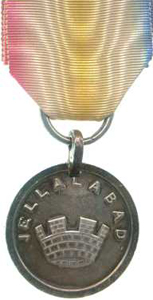
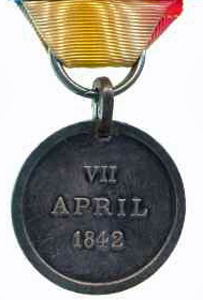
Jellalabad Medal Type 1
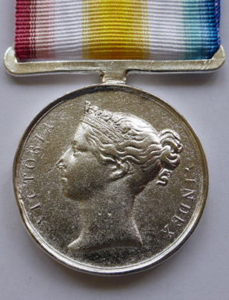
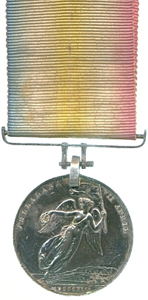
Jellalabad Medal Type 2 Obverse & Reverse
Kelat-I-Ghilzie Medal
The medal was minted of silver. The design of the obverse contained a laurel wreath with mural crown at the top of a shield with the inscription KELAT-I-GHILZIE. The reverse has a trophy of arms on top of a plaque bearing the inscription INVICTA MDCCCXLII. The medal is suspended by a pin, which passes through a steel clip attached to the top of the medal. The ribbon is the watered rainbow colored ribbon common to most East India Company medals. The medals were engraved with the name of the recipient in script on the edge for those medals issued to British personnel. The medals issued to indigenous troops were not engraved.
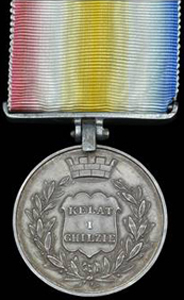
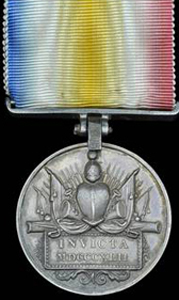
Kelat-I-Ghilzie Medal
Ghuznee Medal
This is a British campaign medal which was awarded for participation in the storming of the fortress of Ghuznee in Afghanistan, from July 21 to 23, 1839 as part of the First Anglo-Afghan War.
This was the second medal awarded to all ranks of the British Army for a specific campaign, the Waterloo Medal being the first. It was struck in 1839 on the orders of Shuja Shah Durrani, the Shah of Afghanistan, to show his appreciation to the British forces, who had restored him to his throne by storming the fortress.
The obverse depicts the fortress of Ghuznee with the word GHUZNEE below, while the reverse has a mural crown surrounded by a laurel wreath and the date 23 JULY 1839. The suspender is straight with a ring passing through a smaller loop affixed to the top of the planchet. Two separate dies exist for this medal with one having a wider border around the edge than the other. The second also has a narrower and taller fortress. The medal was issued unnamed but many were later privately engraved or impressed in varying styles on the reverse or rim.
Ghuznee Medal
Ghuznee Medal
This medal was awarded to those who took part in the First Anglo-Afghan War under the command of General William Nott. Approved by General Order at Simla, India in 1842. It was designed by William Wyon.
There are no official clasps (Marzenia 1842 and Tazeane 1842 were sometimes privately added), but the four reverses indicate for which service the medal was issued. These are (1) CANDAHAR 1842 encircled by a laurel wreath surmounted by a royal crown; (2) CABUL 1842 encircled by a laurel wreath with a royal crown above; (3) GHUZNEE CABUL 1842 inside pair of intertwined laurel wreaths (one surrounding Ghunznee and the other Cabul) surmounted by a royal crown and with the date 1842 centered below; and (4) CANDAHAR, GHUZNEE, CABUL 1842 encircled by a laurel wreath with a royal crown above.
In addition two erroneous strikings were made. In one, VICTORIA REGINA rather than VICTORIA VINDEX appears on the obverse. In the other the reverse reads, CABVL 1842.
Candahar, Ghuznee, Cabul Medal and Cabul 1842 Reverse
Candahar 1842, Ghuznee Cabul 1842, and Candahar Ghuznee Cabul 1842 Reverses
Jellalalbad Medal
This campaign medal, issued by the British East India Company, was established by the Governor-General of India George Eden on April 30, 1842. The medal was awarded for the defense of Jalalabad, to the troops under the command of Brigadier Sir Robert Sale for the defense of Jalalabad between November 12, 1841 and April 16,1842.
The outpost at Jalalabad was no more than a wide place in the road with a fort, held by about 2,000 troops of the 13th Foot Light Infantry under General Sir Robert Sale. After the massacre of the British force during their retreat from Kabul during January 1842, Jalalabad was surrounded by Afghan forces which launched a series of attacks on the fort. The British managed to beat off the assaults and even captures 300 sheep from the besieging force when rations ran short. Eventually, after five months under siege, Sale mounted a counterattack against the Afghan forces, storming and capturing their main camp, baggage, stores, guns and horses. The Afghans fled back to Kabul. The defense of Jalalabad made heroes of the 13th Foot. It is reported that as the regiment marched back through India to return to Britain, every garrison fired a ten gun salute in its honor. Queen Victoria directed that the regiment be renamed13th (1st Somersetshire) (Prince Albert's Light Infantry) Regiment of Foot. Henceforth, they would wear a badge depicting the walls of the town with the word "Jellalabad."
After the relief of Jalalabad, the Governor-General of India created the silver medal for its defenders, but was dissatisfied with the final design. The design featured a Mural Crown on the obverse with the curved inscription, JELLALABAD in the upper half. The reverse contained the three line inscription, VII/APRIL/1942. When a shortfall in the number produced was discovered the opportunity was taken to completely redesign the medal. Those soldiers awarded the first design were offered a free exchange of it for the second issue but very few chose to do so.
The second issue features the young Queen Victoria on the obverse with the inscriptions, VICTORIA on the left and VINDEX on the right. The reverse featured the winged figure of Victory with laurel wreath in her right hand and union jack in her left with the curved inscription, JELLALABAD VII APRIL at top and MDCCXLII below.
Jellalabad Medal Type 1
Jellalabad Medal Type 2 Obverse & Reverse
Kelat-I-Ghilzie Medal
The medal was minted of silver. The design of the obverse contained a laurel wreath with mural crown at the top of a shield with the inscription KELAT-I-GHILZIE. The reverse has a trophy of arms on top of a plaque bearing the inscription INVICTA MDCCCXLII. The medal is suspended by a pin, which passes through a steel clip attached to the top of the medal. The ribbon is the watered rainbow colored ribbon common to most East India Company medals. The medals were engraved with the name of the recipient in script on the edge for those medals issued to British personnel. The medals issued to indigenous troops were not engraved.
Kelat-I-Ghilzie Medal
Website Maintained by Vaudezilla