Indian Campaign Battle Streamers
War Department General Order 19 of February 22, 1862, prescribed that there should be inscribed upon the color or guidons of all regiments and batteries the names of the battles in which they had played a meritorious part.
On February 7, 1890, the use of inscribed battle honors upon the national and regimental colors was discontinued and engraved silver rings, now called silver bands, were authorized. This practice continued until 1918 when the silver bands were in short supply and the War Department authorized the Commanding General, American Expeditionary Forces (General John J. Pershing) to locally procure ribbon as a substitute and inscribe on the ribbon strips the name of special battles and major operations which color bearing units of the American Expeditionary Force had been engaged in during World War I. These ribbon strips became the forerunners of our modern-day campaign streamers.
Hand embroidered silk streamers were first introduced on June 3, 1920 when the War Department authorized a blue silk streamer with the embroidered name of the action. The original directive prescribed that there would be a silk streamer for each war in which the organization participated in the theatre of operations and to be the color of the campaign ribbon for the different wars. The name of the battle or campaign was embroidered on the ribbon.
There were 17 Indian campaigns during the period 1790 to 1891. The Indian War streamer is red with two black stripes. Red is a sacred color with all Indians and is usually considered symbolic of strength and success. The color red, symbolic of war, is also a symbol of the day and the Sun god. The color black is symbolic of death and mourning and is also a symbol of night and the underworld god.
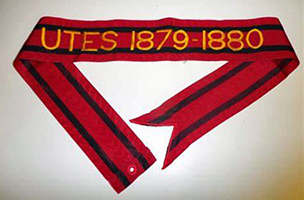
Indian War Campaign Streamer for the Meeker Massacre
The following 14 campaign streamer inscriptions in yellow were authorized:
War Department General Order 19 of February 22, 1862, prescribed that there should be inscribed upon the color or guidons of all regiments and batteries the names of the battles in which they had played a meritorious part.
On February 7, 1890, the use of inscribed battle honors upon the national and regimental colors was discontinued and engraved silver rings, now called silver bands, were authorized. This practice continued until 1918 when the silver bands were in short supply and the War Department authorized the Commanding General, American Expeditionary Forces (General John J. Pershing) to locally procure ribbon as a substitute and inscribe on the ribbon strips the name of special battles and major operations which color bearing units of the American Expeditionary Force had been engaged in during World War I. These ribbon strips became the forerunners of our modern-day campaign streamers.
Hand embroidered silk streamers were first introduced on June 3, 1920 when the War Department authorized a blue silk streamer with the embroidered name of the action. The original directive prescribed that there would be a silk streamer for each war in which the organization participated in the theatre of operations and to be the color of the campaign ribbon for the different wars. The name of the battle or campaign was embroidered on the ribbon.
There were 17 Indian campaigns during the period 1790 to 1891. The Indian War streamer is red with two black stripes. Red is a sacred color with all Indians and is usually considered symbolic of strength and success. The color red, symbolic of war, is also a symbol of the day and the Sun god. The color black is symbolic of death and mourning and is also a symbol of night and the underworld god.
Indian War Campaign Streamer for the Meeker Massacre
The following 14 campaign streamer inscriptions in yellow were authorized:
| CAMPAIGN | DATES |
| MIAMI | 1790-1795 |
| TIPPECANOE | 1811 |
| CREEKS | 1813-1814; 1836-1837 |
| SEMINOLES | 1817-1818; 1835-1842; 1855-1858 |
| BLACK HAWK | 1832 |
| COMMANCHE | 1867-1875 |
| MODOCS | 1872-1873 |
| APACHE | 1873; 1885-1886 |
| LITTLE BIG HORN | 1876-1977 |
| NEZ PERCE | 1877 |
| BANNOCKS | 1878 |
| CHEYENNE | 1878-1879 |
| UTES | 1879-1880 |
| PINE RIDGE | 1890-1891 |
Website Maintained by Keith Emroll