HEIC Medal for the Anglo-Nepalese War (1816)
The Anglo-Nepalese War (1814–16), also known as the Gurkha War, was fought between the Kingdom of Gurkha (present-day Federal Democratic Republic of Nepal) and the East India Company as a result of border disputes and ambitious expansionism of both the belligerent parties. The war ended with the signing of the Treaty of Sugauli in 1816, which ceded around a third of Nepal's territory to the British. HEIC was the invading forces, while the Nepalese maintained a defensive position. The British attacked in two successive waves of invasion. It was the most expensive war waged during the governorship of Lord Moira of ten years.
The war concluded with the Treaty of Sugauli, which was ratified on March 4, 1816. Nepal lost all Sikkim (including Darjeeling), the territories of Kumaon and Garhwal and western Terai . The Mechi River became the new eastern border and the Mahakali River the western boundary of the kingdom. The British East India Company would pay 200,000 rupees annually to compensate for the loss of income from the Terai region. Kathmandu was also forced to accept a British Resident. The fear of having a British Resident in Kathmandu ultimately proved to be unfounded, as the rulers of Nepal managed to isolate the Resident to such an extent as to place him under virtual house arrest.
This HEIC medal was not a general campaign medal, but rather it was awarded in gold (2) and silver (45) to those HEIC soldiers, who displayed especially meritorious service in the campaign. The obverse features a cannon firing at a fortified mountain top. The reverse has a Persian inscription, which reads, THIS MEDAL WAS CONFERRED BY THE NAWAB GENERAL GOVERNOR (MARQUIS OF HASTINGS) BAHADUR, IN TESTIMONY OF THE ENERGY, GOOD SERVICE, SKILL AND INTREPIDITY WHICH WERE DISPLAYED IN THE HILLS IN THE YEAR OF THE HEGIRA 1229 AND 1230.
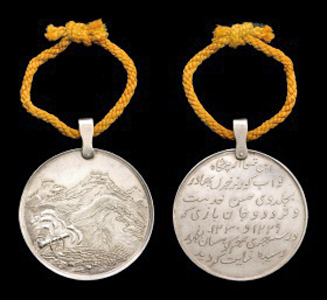
Medal for the Anglo-Nepalese War
The Anglo-Nepalese War (1814–16), also known as the Gurkha War, was fought between the Kingdom of Gurkha (present-day Federal Democratic Republic of Nepal) and the East India Company as a result of border disputes and ambitious expansionism of both the belligerent parties. The war ended with the signing of the Treaty of Sugauli in 1816, which ceded around a third of Nepal's territory to the British. HEIC was the invading forces, while the Nepalese maintained a defensive position. The British attacked in two successive waves of invasion. It was the most expensive war waged during the governorship of Lord Moira of ten years.
The war concluded with the Treaty of Sugauli, which was ratified on March 4, 1816. Nepal lost all Sikkim (including Darjeeling), the territories of Kumaon and Garhwal and western Terai . The Mechi River became the new eastern border and the Mahakali River the western boundary of the kingdom. The British East India Company would pay 200,000 rupees annually to compensate for the loss of income from the Terai region. Kathmandu was also forced to accept a British Resident. The fear of having a British Resident in Kathmandu ultimately proved to be unfounded, as the rulers of Nepal managed to isolate the Resident to such an extent as to place him under virtual house arrest.
This HEIC medal was not a general campaign medal, but rather it was awarded in gold (2) and silver (45) to those HEIC soldiers, who displayed especially meritorious service in the campaign. The obverse features a cannon firing at a fortified mountain top. The reverse has a Persian inscription, which reads, THIS MEDAL WAS CONFERRED BY THE NAWAB GENERAL GOVERNOR (MARQUIS OF HASTINGS) BAHADUR, IN TESTIMONY OF THE ENERGY, GOOD SERVICE, SKILL AND INTREPIDITY WHICH WERE DISPLAYED IN THE HILLS IN THE YEAR OF THE HEGIRA 1229 AND 1230.
Medal for the Anglo-Nepalese War
Website Maintained by Vaudezilla